Tuesday, September 23, 2008

To what extent does where we come from impact where we (can) go?

This past spring, Jim Leftwich, Chief Experience Officer at SeeqPod, was a guest speaker at my "User Experience Managers and Executives Speak" course, where he described the evolution of his career, beginning with his childhood encounter with a tractor throttle (see photo). What was striking was the extent to which Jim's approach and way of working was influenced by that encounter and has continued to reflect his experiences growing up on an Iowa farm.

According to Jim, his Dad was a businessman, a veternarian, a carpenter, an engineer, ... -- a little bit of everything. Well, Jim's approach has usually been one of doing most everything himself, and in college, he studied a little bit of everything, including engineering, economics, business, fine arts, photography, psychology, graphics, typology, and industrial design, all of which he continues to apply in his work. Jim told of how his Dad would say, "Let me know what you need, and I'll tell you how to get along without it," a philosophy -- an approach -- reflected in Jim's work throughout his careeer.

To what extent does our work, our approach, our thinking, ... continue to reflect our early experiences?

During the recent IDSA 2008 conference, a surprising number of speakers began their presentations by describing their early experiences and how those early experiences are reflected in their thinking and work today.

During BayCHI's program two weeks ago, Bill Verplank sketched numerous metaphors, including his definition of "interaction design," a term Bill is credited for having co-coined. Bill has made and presented this sketch before; indeed, you can watch him do so in a video that is available on the webpage corresponding to an interview of Bill that appeared in the book, "Designing Interactions." What was new this time was Bill's statement that he only recently realized his definition of "interaction design" reflected his early days as a controls engineer. And though his definition includes attending to how users feel, Bill stated that the focus of his work has never really moved on to "user experience," which includes an emotional component that was never the focus of his early work.

In the delightful book "Eat Pray Love," Elizabeth Gilbert writes:
"When you are walking down the road in Bali and you pass a stranger, the very first question he or she will ask you is, "Where are you going?" The second question is, "Where are you coming from?" To a Westerner, this can seem like a rather invasive inquiry from a perfect stranger, but they're just trying to get an orientation on you, trying to insert you into the grid for the purposes of security and comfort. If you tell them that you don't know where you're going, or that you're just wandering about randomly, you might instigate a bit of distress in the heart of your new Balinese friend. It's far better to pick some kind of specific direction -- anywhere -- just so everybody feels better."
In a more abstract sense than intended by Elizabeth, is the first question even necessary once you learn the answer to the second? The above stories about Jim, Bill, and several IDSA conference speakers suggest that the answer might be, "no." And it seems to me that most people think the answer is, "no." That is certainly the case of the historical analyst interviewed on National Public Radio recently who argued that the early experiences of the two major U.S. presidential candidates reveal exactly what kind of presidents they would be.

Why am I thinking and writing about this? Well, it was my birthday recently, and as I told a couple of friends, the occurrence of my birthday had led me to become excessively introspective. "Watch out," they wisely responded!

But I think I've long been a bit disturbed by the extent to which people get defined by "where they are coming from" -- that once people reveal that kind of information (whether it is about the geographic area in which they grew up or the profession or professional association in which they "grew up" or the "era" in which they grew up or...), others' preconceived notions of what it means about who they are and "where they are going" or where they can go kick in. Such "preconceived notions," as I described in a blog entry of that title, are very hard to change.

Yet, many of those preconceived notions may have been shaped by early experiences, perhaps explaining their resistance to change.

The relevance of all of this to this blog? Well, this blog is largely about achieving change, as I am certainly in the "change business," helping individuals and organizations change their work practice, management, and organizational strategy via my consulting, teaching, and co-chief-editorship of interactions magazine.

And many have argued that anyone working in this field is or should be in the same change business. For example, in an earlier blog entry about this, I quoted Secil Watson:
"Think of yourselves as change agents. If you like that role, then look at of yourselves as the people who can really change the culture of the organization you are a part of."
Mark Hurst has been arguing for years that changing the organization "is the most important part of user experience work." But he also argues that changing the organization is "the most difficult" part of user experience work.

Indeed, as you probably know, it is usually VERY difficult, which is why there are people like me available to provide guidance.

The huge response to "Eat Pray Love" reveals that Elizabeth Gilbert is in the "change business" as well. Though her "change business" is rather different from mine and yours, perhaps the end of the above quote from her book offers partial guidance regarding how to respond if you haven't yet formulated a good change strategy. In short, "pick some kind of specific direction -- anywhere -- just so everybody feels better."

But then get to work on developing a good change strategy.

Saturday, August 30, 2008

On innovation, appropriateness, intervention design, logic, research, the experience ecosystem, marketing, sustainability, wicked problems, and more

Jon Kolko and I -- Co-Editors-in-Chief of interactions magazine -- end each issue of the magazine with a "cafe" conversation on topics of relevance to the magazine's content. Jon always kicks off these conversations in a provocative but insightful way.

Here are the openings of, and pointers to, our first five "interactions cafe"s:

On Innovation, Appropriateness, Intervention Design, ... (January+February 2008)

Jon: I’m concerned with the overabundance of the word “innovation” in our professional discipline. At CONNECTING ‘07, the theme was neither subtle nor convincing: nearly every speaker talked about innovation (some better than others), yet no one over the course of four days managed to define the term. Apparently, if a business isn’t focused entirely on innovation right now, their business is completely ruined and they won’t be around in a hundred years.

But I’ve recently done a mental inventory of the products, software and services that I use and that I cherish. The items I hold dear to my heart are either one-offs (craft oriented and thus not in the realm of the innovation discussion) or refined and subtle: they are appropriate more than they are innovative. As we see a trend in society towards “slow” design [clearly juxtaposed with fast food culture], the bloat of features and functionality that seem to go hand in hand with being new and different seem dramatically misplaced.

On top of this, the majority of the companies that are clamoring for increased innovation haven’t proven that they can solve the older problem of quality: I don’t need more ‘new’ and ‘innovative’ features in Windows; I just need the bloody thing to work without crashing.

You do a lot of coaching and teaching companies to be more innovative. Why don’t you get them to be more appropriate, or refined, or polished, instead?

Richard: Actually, my coaching and teaching focus on moving “user experience” into a position of greater corporate attention and influence — on helping to enable companies to do the kinds of things Secil Watson describes in her article in our first issue of interactions. Roger Martin referred to this as “intervention design” in his conference plenary on “Design Thinking: The Next Competitive Advantage,” and I’m sure we’ll offer (more) articles on this in future issues.

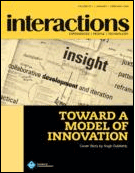
Sometimes such interventions mean helping companies organize and do things in such a way that more appropriate, refined, or polished user experiences will result. But they do sometimes mean helping companies do things so that they can be more innovative. However, innovation can be an important part of making user experiences more appropriate, refined, or polished. I think Hugh Dubberly’s model of innovation in our first issue captures that.

Hugh’s model also addresses the insight required of all of this, stating that “immersion within the context is almost always essential” to achieve such insight. I often coach and advise companies on how to achieve such immersion effectively, and the article by Stefana Broadbent and Valerie Bauwens contributes guidance as well. That article also reveals ethnographic research findings that advise against certain types of innovation since they are likely to yield user experiences that are inappropriate.

Clearly, ethnographic research...

(continue reading "On Innovation, Appropriateness, Intervention Design, ...")

On Logic, Research, Design Synthesis, ... (March+April 2008)

Jon: A core theme of this issue of interactions has been the relationship between Interaction Design and education: how to teach it, how to learn it, and how to live it. As a Designer, I’m obviously biased towards Design Education, as I see Design as a core tenant of life (consider it akin to reading and writing: design has often been characterized as “dreaming” or “problem solving”, both of which I consider underpinnings of human life). At the same time, I see the value in logic and pragmatism, and I’m often challenged professionally to “prove it” or “back it up with a sound, logical argument”. Do you think future generations of professionals in the interaction world will have to walk the line between Art (emotion) and Science (logic), or will Design with a capital D finally have its time to shine?

Richard: Can design truly shine without addressing both emotion and logic? Was a need to walk the line between art and science responsible for all the messes described in the first section of this issue (entitled "The Mess We've Gotten Ourselves Into"), or is the culprit better described as an improper balance?

Roger Martin, whom we referenced in our first “interactions cafe” discussion, has written about how the predominant thinking in business — analytical thinking — is hostile to design, and how that needs to change. But he doesn’t argue that analytical thinking has no place.

Perhaps you can’t “prove it.” Perhaps you shouldn’t be expected to “prove it.” But is it wrong to expect you to develop and use and provide rationale that can be subjected to some form of critique throughout and after the design process?

Is Tracy Fullerton wrong in teaching and emphasizing the importance of playtesting in her Interactive Entertainment program at the USC School of Cinematic Arts? Was Mark Baskinger wrong to observe the elderly and kids in his inclusive design projects? Doesn’t such research contribute to a kind of “logical argument” that is essential?

Jon: I wonder if the word “rationale” should even be part of the designer’s language. ...

(continue reading "On Logic, Research, Design Synthesis, ...")

On the Experience Ecosystem, Drama, Choreography, ... (May+June 2008)

Jon: This issue clearly demonstrates a shift in thinking for practicing designers. Creators of physical, digital, and systematic products are moving away from the development of single, static things and are now considering the larger ecosystem of the experience in which these things are used. This experience lifecycle has even touched on children’s toys, as described by Allison Druin; it is no longer enough to offer products with a narrow focus. Instead, practitioners must “design” the physical artifact, the digital artifact, the system of integration, the unboxing experience and must even consider the urban fabric and culture in which the design is used.

It seems like few, if any, large corporations are organized in a way that supports this tremendous undertaking; the actual experience offering from these corporations is so watered down by the time it makes it to market that all indications of cohesion are lost.

Richard: Years ago I had the good fortune of working at Studio Archetype and Viant, where the focus was on helping clients figure out what to do as much as designing how to do something. Indeed, the Studio’s founder, Clement Mok, wrote a book entitled "Designing Business" back then, and Viant’s primary focus was on developing digital business strategy.

So, the approach to user research that I developed for both companies somewhat naturally looked at the larger ecosystem of the user experience, since that increased our contribution to figuring out what a business should do and facilitated designers’ contribution to the same.

Companies that involve user experience research and design in their business in such ways have a better chance of effectively considering and addressing that bigger picture. Secil Watson wrote of taking such an approach at Wells Fargo in our January+February 2008 issue. But it is hard to pull that off.

You attended Interaction 08 in...

(continue reading "On the Experience Ecosystem, Drama, Choreography, ...")

On Marketing, Sustainability, Pessimism, ... (July+August 2008)

Jon: I’m tired of advertising, and to be completely frank, I’m tired of marketing. The entire infrastructure for corporate marketing has arisen from a desire to convince the public that they need more, faster, better, now. We keep talking about sustainability, but we - and I include myself in this, as I work at a consultancy that makes *things* - keep producing more stuff, and keep thinking about ways to sell versions two and three and four of the stuff to people that don’t really need it in the first place.

What are we doing?

Richard: Change of such great magnitude doesn’t happen overnight. Some of the marketing you are tired of — that which describes what companies are doing to address sustainability — might suggest otherwise, but…

Of course, making “things” won’t go away, but the nature of those things can promote sustainability, as reflected in our cover story. And the way the consultancy you work at responds to clients who want you to make things for them can increase sustainability, as reflected in the Designers Accord described in our May+June issue; indeed, I think you can be proud that that accord was born where you work — frog design.

The Designers Accord is a very important effort, and I...

(continue reading "On Marketing, Sustainability, Pessimism, ...")

On Addressing Wicked Problems... (September+October 2008)

Jon: A lot of the discourse that surrounds interaction design speaks to the large, cultural change it can afford. When I used to teach, my students would become enamored with the possibilities of design, and would make grandiose, and unintentionally trivializing statements like "World hunger? It's just a design problem; we could solve it, if only we had the right model..." This issue of interactions presents a number of these types of problems: homelessness, sustainability, and memory impairment. Do you feel that we actually can solve these wicked, cultural problems through design?

Richard: Design can play an important role. As we suggest in our introduction to this issue design is changing in ways that should increase the role it can play. And increased adoption of "design thinking" by others -- as we've referenced in previous interactions cafes -- will help as well.

But let's take care to not treat design as if it were a religion or a savior. Agile development methodologies, with more than a few fanatical followers, are, in some cases, justifiably decried as little more than an excuse to not document code. The OLPC hasn't had, and is unlikely to have, much of an impact on children's education in developing nations.

Jon: The two examples you give share an interesting commonality. ...

(continue reading "On Addressing Wicked Problems...")

Coming in the November+December 2008 issue: On Mobile Communication, Cultural Norms, ...

Sunday, August 10, 2008

Eliminating noise and confusion

With lots to do -- often much too much to do and not always what would be most beneficial for them to do (as referenced in prior blog entries, including "Realities, dilemmas, framings, ..."), user experience personnel aren't always able to do their best work, which can make them and those with or for whom they are doing the work less than fully satisfied. Past blog entries have referred to some of the ways of dealing with this; recent blog entry suggestions include saying "no," improving soft skills, and offloading certain types or parts of the work to others.

But there are additional possibilities.

One of them -- which can come in all sorts of variations -- was described by Craig Peters during the User Experience Managers and Executives Speak course I offered this past spring. Craig founded and oversees the work at Awasu Design and was co-founder of Bolt | Peters.

Craig has discovered that even some of the best user experience organizations and personnel, and the organizations and personnel with or for whom they work, are continually experiencing a considerable amount of noise and confusion, which gets in the way of doing the best or most appropriate work.

User experience personnel have long expressed frustration with others' lack of understanding of and appreciation for them and their work, (potential) users, and/or the impact user experience can have on business success. This has prompted many to develop materials to be used as part of ongoing "evangelizing" efforts.

However, such efforts, while important, are usually not all that is needed. Noise and confusion often persist, in part because there are additional sources of noise and confusion, many of which are experienced by user experience personnel themselves.

Among these additional sources of noise and confusion:
  • an inadequate understanding of the organizations for or with which you do your work;
  • an inadequate understanding of the organization you are in;
  • an inadequate understanding of the processes used by the organizations for or with which you do your work;
  • lack of certainty regarding who is responsible for what;
  • and lack of certainty regarding how to negotiate with and explain the work you'll be doing to those for or with whom you'll be working.
As explained by Craig, such noise and confusion leads to all sorts of problems, including:
  • others' inconsistent experiences of user experience personnel and their work from project to project;
  • work activity selections that are not the best for the situation;
  • things falling through the cracks;
  • scheduling and timing difficulties;
  • unwanted creeping project scope;
  • management needing to step in much too frequently to solve problems;
  • designs that are not as good as they could be;
  • and missed opportunities to do work that is particularly needed or particularly strategic.
All of these kinds of problems hinder critical working relationships and leave personnel feeling overwhelmed and unhappy.

Craig described the process followed to discover the nature and characteristics of such problems and to design their solutions in work done for Wells Fargo. And he described the nature of part of the solution developed for and with Wells Fargo personnel. At Wells Fargo, the core of the solution was a Customer Experience Lead program, complete with a guide and a collection of materials and tools to be used by whomever plays the role of Customer Experience Lead on a project. (Those materials and tools included organizational explanations, forms for a customer experience brief, numerous checklists, and numerous one-page explanations of customer experience work activities.) Additionally, a new stage was added to their user-centered design process, training was developed for Customer Experience Leads, and various personnel were designated owners of different components of the program, providing a mechanism for making improvements to the program going forward.

The program developed for Wells Fargo is receiving rave reviews. Wells Fargo's Secil Watson, SVP of Channel Strategy -- the organization which includes the Customer Experience group -- even recommended Craig and this type of work during her presentation at MX (Managing Experience) 2008.

What I think makes this kind of effort especially valuable is that it puts organizations in a much stronger position to address many other critical issues (see past blog entries for discussions of many examples of these) that the noise and confusion can cloud. And if done correctly, the process for identifying the nature and characteristics of such noise and confusion will begin to reveal the nature and characteristics of other critical issues, providing guidance for subsequent improvement efforts.

It is important to emphasize that the program developed for Wells Fargo will not be the solution for noise and confusion experienced elsewhere, whether involving an "internal" organization (akin to the organization in Wells Fargo) or an "external" agency. Certain components might be similar, but the program developed for Wells Fargo is working because it fits the way things work at Wells Fargo and addresses their specific needs. Things work very differently in different companies.

It is also important to emphasize the high quality of the customer experience (and related) personnel at Wells Fargo. For example, I've referenced and quoted Secil Watson repeatedly in this blog (see, for example, "Breaking silos"), and I invited her to write an article for my first issue of interactions magazine as Co-Editor-in-Chief (which she did -- see "The Business of Customer Experience: Lessons Learned at Wells Fargo"), because I think so highly of her approach. I've also referenced the excellent work done by other Wells Fargo management personnel in this blog (see, for example, "Developing user-centered tools for strategic business planning"). Highly capable and successful personnel are not immune from such noise and confusion or from the benefits of outside assistance regarding it or other important issues. And they recognize that.

Craig and I are now teaming up to offer such assistance. Give us a holler to learn more.

Thursday, June 19, 2008

Bridging communities via interactions

The title of this blog entry is intended to have a double meaning. First, it references how interactions are essential to bridging communities -- something essential for "user experience" to play the role it should be playing in business. Second, it references how interactions magazine will increasingly reflect and attempt to facilitate this process.

Jon Kolko and I -- Co-Editors-in-Chief of interactions magazine -- have talked about the latter in the magazine, particularly in the introduction to our second issue. We elaborated on this and described other aspects of our goals and vision during a session we put together about the magazine for CHI 2008 in Florence. Here are the slides we used during that session:


interactions magazine has been around for awhile -- since January 1994 to be exact. During the CHI conference session, Timelines editor Jonathan Grudin and Advisory Board member Shelley Evanson described what it took to get ACM to begin publication.

We also "performed" the magazine to give attendees a rich sense of what the magazine is now about and of who its regular contributors are. (Thanks to Allison Druin, Fred Sampson, Eli Blevis, Jonathan Grudin, and Elizabeth Churchill who, along with Jon and myself, contributed readings during this part of the session.)

Additionally, Jon facilitated an important discussion between Elizabeth and special guest Mark Vanderbeeken about the concept of open access to intellectual content and its relevance to interactions magazine. (Sorry that Mark's head is largely obscured by Elizabeth's in the nearby photo.) One might argue that open -- i.e., free -- online access to interactions magazine content would in and of itself help to bridge the communities for which interactions magazine is of relevance. However... (Portions of and extensions to the CHI 2008 discussion will appear in Elizabeth's column and in "interactions cafe" in the September+October issue; both of those articles will be made available via the interactions website to all, facilitating everyone's opportunity to respond and share his or her perspective.)

---
Note that you can hear me talk a bit about interactions magazine via a podcast created during the Mx 2008 conference for Boxes and Arrows. See "Leading Designers to New Frontiers: Podcasts from MX San Francisco."

Black and white photo above by Eli Blevis.

Wednesday, June 11, 2008

Soft skills

Early last month, I spent a long weekend in a facilitation skills class. I've taken facilitation classes before, I do and have done a lot of facilitation in my work, and I'm considered to be very good at it. However, I was delighted to have the opportunity to reexamine some of the basics, work on some of the things that can be rather challenging, and receive (and give) feedback from (and to) others doing the same.

Facilitation skills are among those so-called "soft skills" that many argue are critical to the success of experience management and non-management personnel who more often than not find themselves working in "hostile territory."

As Lisa Anderson, Director of User Experience at Autodesk, argued during her appearance as a guest speaker in my recent User Experience Managers and Executives Speak course: "We're the glue that binds -- that brings different people and thinking together." Hence, "the soft skills, too often neglected by user experience managers, are critical. Develop these in yourself and your team."

Jim Nieters, Director of User Experience at Yahoo! and another of my guest speakers, has stressed that user experience practitioners need strong teamwork, communication, and advocacy skills just to get product teams to want to work with them. And another guest speaker, Klaus Kaasgaard, Yahoo!'s VP of Customer Insights, addressed this from the perspective of the researchers whose work he oversees:
"It is all about getting people on your side. Researchers won't get an SVP of business to act just by presenting their insights. One needs to build momentum to get people behind you in order to convince them, which is a long process. You have to wear 2 hats -- your scientist hat and your strategy and business hat, which is like becoming a different person. This is difficult for all of us to learn."
During presentations at HCIEd08 and Mx 2008, I included the need for experience management and non-management personnel to develop soft skills among several of the key challenges that need to be better addressed (see "Realities, dilemmas, framings, ..."). And since then, it has been great to see soft skills given center stage at an IxDA-SF presentation entitled, "Herding Cats and Taming Lions: Using Facilitation Skills to Create Better Design," and at a Slideshare event entitled, "An Evening of Presentation Zen."

Look for and take advantage of opportunities to further develop your "soft skills." (And don't overlook your local improv classes.)

Wednesday, June 04, 2008

Roles and Relationships

In two of my most recent three blog entries, I argued that too much of the work done by user experience professionals ends up not being beneficial.

A good example of this was described last evening by TiVo's Margret Schmidt (VP of User Experience Design and Research, and pictured nearby) and Elissa Lee (Sr. Director of Research) during a presentation entitled, "Bringing the Spirit of the DVR to the Web: TiVo Launches a New tivo.com."

The abstract of that presentation:
"TiVo is often noted for its friendly TV experience. We recently launched a new version of tivo.com designed to bring that same simplicity and ease-of-use to our web presence. It took a close partnership between User Experience and Marketing, the right balance of internal and external design leadership, and a strong internal research team dedicated to continuous feedback in order to make the design a success. We'll discuss how we structured the project, the research techniques we used, and what we learned along the way."
The third sentence of that abstract -- italics added by me -- stands in sharp contrast to what happened during a redesign of tivo.com a year earlier -- a redesign that, even though built, was never launched. The slide to the left outlines some of the key reasons for that failure. In short, roles and relationships were all messed up, and TiVo executives, helped by results of post-design usability testing conducted by the internal research team, recognized that a launch of the redesigned site would be highly inadvisable.

Frustrated by this and related experiences, Margret went to Marketing and asked what she could do so that this kind of thing would not happen again. To her delight (and probable surprise), she was asked to lead the next attempt. More of what was new about the next attempt is outlined in the slide to the right. The timelines were still unrealistic, resulting in long hours locked away in a "war room" to get things done -- see those same two recent blog entries of mine about how user experience professionals are too often overwhelmed with work. And the nature of the involvement of and relationship with the external agency was still not ideal -- a problem so many companies experience. But this time, everyone bought into the vision and the approach, and the redesign was not a waste of time and effort.

One can argue that the failure of last year was necessary to enable the success of this year. Indeed, failures of such magnitude often create golden opportunities to make needed adjustments to roles and responsibilities (and process and ...). However, though often hard if not impossible (see, for example, "'There is only so much air in the room'"), do whatever you can to get the roles and relationships right from the start.

Monday, June 02, 2008

Offloading work to others

In a recent blog entry, I claimed that many experience management and non-management personnel are overwhelmed with work, too much of which is often not that beneficial to a company, because of, among other reasons, the inadequate involvement of user experience personnel in determining what that work should be.

Another reason was described by Jeremy Ashley, VP Applications User Experience at Oracle, when he appeared as a guest speaker during my "User Experience Managers and Executives Speak" course earlier this year:
"Designers are expected to do too much -- to be project managers, liaise with PMs, liaise with marketing, liaise with development, liaise with executives, write technical specifications, and more, and while doing all these other things, they are expected to design the product. This is an impossible task. Designers are almost set up to fail at the start, because expectations are unrealistic."
According to Jeremy, at one time, Oracle designers were able to design only 20% of the time. So, among other things, he offloaded a lot of those non-design tasks onto other personnel. For example, he hired and now has a staff of user experience program managers who have taken over responsibility for lots of the liaising with others in the company.

Responsibilities of this role, outlined by Oracle's E. Killian Evers in the November 2007 AIS SIGHCI Newsletter, have included integrating, and continually improving the integration of, human-centered design into Oracle's system development lifecycle, and figuring out the most advisable projects to which Oracle's user experience resources should be assigned. Furthermore...
"Program managers are tasked to think beyond the usability organization to include partners in other parts of the larger organization. Effective partners can be found in program management, product management, strategy, development, quality assurance, technology writers, as well as in the sales and support divisions within the company. Program managers' responsibilities include leveraging resources from any of these organizations as needed to assist on projects."
Other companies have created related roles. For example, while at Microsoft, Kumi Akiyoshi served as a UX liaison responsible for building relationships with marketing, advertising, and branding.

Years ago, E-Lab assigned responsibilties for doing the work necessary to effectively communicate experience research findings to specially trained visual communicators, rather than being left (solely) to the researchers. Similarly, interaction designers at Cooper partner with design communicators who "lead teams in communicating research, requirements, and design solutions the right way to the right audience at the right time."

Some companies have created roles to facilitate the development of user experience methodology and/or a corporate culture that embraces design and design thinking. For example, Microsoft has a Design and Usability Training Manager (Surya Vanka), P&G a VP of Design Innovation & Strategy (Claudia Kotchka, whom I've referenced in three past blog entries), and SAP a Sr. Director of User Experience, Methods (Carola Thompson, former student of mine and another guest speaker at my "User Experience Managers and Executives Speak" course earlier this year -- see photo nearby).

Should you consider offloading some of the work of your user experience personnel to others, some of whom would occupy new user experience roles?

Friday, May 09, 2008

"There is only so much air in the room"

Listening to the great Bill Moyers tell Charlie Rose that "too many powerful interests have a stake in the dysfunction of government that they don't want to fix what is the fundamental structural problem" reminded me of some of the things John Armitage, Director of User Experience at Business Objects, emphasized when he appeared as a guest speaker during my "User Experience Managers and Executives Speak" course earlier this year.
"There is only so much air in the room -- only so much budget, head-count, attention, and future potential in an organization. And people within the organization are struggling to acquire it -- struggling for power, influence, promotion, etc. whether because of ego or as a competitive move against threats of rivals. People will turn a blind eye to good ideas if they don't support their career and personal objectives. Hence, if user experience is perceived as a threat, and if they think they can stop it, they will, even if it hurts the company."
Stating that it is management's responsibility to prevent this from happening, John cautioned that it is hard to build incentives and checks and balances to get organizations to "let user experience in," particularly where user experience is the new kid on the block (as it is in most companies). To get organizations to let user experience in, "you have to take power away from people who have it now."

John argued that you ultimately need to pose the following question to those who have the power now: "Is it better to have a small part of a bigger thing or a big part of a small thing?” Hence, in an engineering-dominated company, it is engineering that needs to be convinced that by giving up some headcount and influence to user experience personnel, the company will grow bigger than it otherwise would, and all will benefit.

John referred to a common obstacle to this: given that the importance of user experience isn’t a secret anymore, everyone -- engineering, marketing, even the president of the company -- might claim to be a user experience expert.

Does this describe how things are where you work? Are those in power unwilling to give up as much of their power as would be most beneficial to your company? What do you need to do in order to convince them to do so?

Wednesday, April 30, 2008

Realities, dilemmas, framings, ...

"Thanks for your presentation. You're the only presenter to have spoken about the dilemmas we face. Most of the other speakers have been providing their 3- or 4-part prescriptions for success almost as if we will confront no challenges to following them!"
Describing aspects of the everyday reality that managers of user experience often live in was what I had been asked to do as part of my presentation at Mx 2008 last week in San Francisco, which is where I received the above feedback. And I described the same in a very different context early in the month as part of a presentation at HCIEd08 in Rome.

My focus in both cases was (a subset of) the difficulties, the challenges, the dilemmas, ... which such personnel need to address to be able to play a strategic role in the companies in which they work.

What claims did I make about that everyday reality? A slide summarizing the claims appears nearby. (You can click on it to enlarge it.)

As an example, here is something akin to what I said about claim #1:
"'Experience management and non-management personnel are often overwhelmed with work.' In a sense, this is good, as it reveals that the demand for services is now high, which has not always been the case. But this is actually not so good, because it often hurts the quality of the work they do, and it often means that people are working on things that are not that important, that are not that impactful. Hence, the solution isn't necessarily one of adding more personnel or hiring contractors; that often isn't even an option. But there are solutions, solutions which will actually enable one to secure the budget to add more personnel more quickly. But because the experience personnel are so overwhelmed, they often don't have the time or mental space to step back, assess the situation, and figure out what those solutions are. So they are often stuck, and they are often stuck doing work that is not important and often a waste of their time and effort and a waste of their company's time and resources."
In Rome, I followed my description of the challenges with an assortment of ideas about how the challenges might be met via new or modified or extended "educational experiences" for management personnel, and I encouraged attendees -- note that HCIEd08 was a conference for educators -- to generate additional ideas.

In San Francisco, I followed the description with examples of the ways successful experience managers and executives have framed such challenges in order to address them. For example, I described how Jeremy Ashley, VP Applications Experience at Oracle, argues the importance of seeing design not as a service, but as a driver and differentiator of the process. I told of how Lisa Anderson, Director User Experience at Autodesk, similarly argues the importance of prioritizing and focusing -- of not taking on all requests so to not be treated like a service organization -- of how it is better to change one feature by 70% than to change several by 10%. I told of how Klaus Kaasgaard, VP Customer Insights at Yahoo!, argues that too much research being done is tactically focused because researchers have not been good at saying "no" -- that it had been the case at Yahoo! that success was measured by the number of projects done and how few they said "no" to: "We would then get a bonus for executing on all requests, though doing so had limited our impact on the business." And I reminded attendees that in a presentation earlier that day at the Mx conference, Cordell Ratzlaff, Director User-Centered Design at Cisco, had also argued the importance of saying "no."

Then I asked: "Do you say 'no' where you work? Dare you? Would you remain in your job if you did? Or would you find that people would be happy if you were to start saying 'no'? What might need to be true before you consider using that strategy?" (Note that not all successful experience managers and executives have taken such an approach.)

In a workshop, I would have asked attendees to answer such questions and to discuss the pros and cons of that particular framing and approach as well as of many others to help them figure out which framing and approach or what combination of framings and approaches or what variation of a framing and approach is something they should consider attempting in their workplace.

I'll be sharing more framings and approaches in upcoming blog entries.

---
Jeremy, Lisa, and Klaus were among the wonderful user experience managers and executives who appeared as guest speakers during my recently concluded, "User Experience Managers and Executives Speak" course.

Saturday, March 29, 2008

Audio and slides for "Moving UX into a position of corporate influence: Whose advice really works?"

Here are the slides from and the audio of my CHI 2007 conference session entitled, "Moving UX into a position of corporate influence: Whose advice really works?" Start the audio, then flip through the slides. (This is not ideal, but the SlideShare's synchronization tool defeated my attempt at synchronizing the audio with the slides).

For a sense of how the members of the panel repositioned themselves on stage during the session (which you'll be able to hear but not see), read "So, whose advice really works?"

Participants (other than me):
  • Jeremy Ashley, Vice President of Applications User Experience, Oracle
  • Secil Tabli Watson, Senior Vice President Internet Channel Strategy, Wells Fargo
  • Manfred Tscheligi, Director of the Center for Usability Research & Engineering, Wein Austria (representing Tobias Herrmann, Head of Team User Experience, mobilkom austria)
  • Shauna Sampson Eves, Director of User Experience, Blue Shield of California
  • Jim Nieters, Senior Manager User Experience Design, Cisco
  • Justin Miller, Senior Director of Product for Europe, eBay
  • a large audience in a large, spacious auditorium
---
Photo by Pabini Gabriel-Petit.

Tuesday, February 19, 2008

On the importance of alignment, trust, loyalty, ...

Does it matter where user experience personnel are positioned in the organizational structure of your company, and how their work is funded?

"Yes," according to Jim Nieters, a Director of User Experience & Design at Yahoo! and former Senior Manager of User Experience Design at Cisco. As guest speaker at the first meeting of my "User Experience Managers and Executives Speak" offering, Jim compared characteristics of a variety of organizational and funding models -- centrally-funded, client-funded, distributed, consultancy, and hybrid -- and shared stories of his experiences with each.

Though many claim that there is one best model for user experience, Jim argues that there is a right model in every company, but that that right model is not the same in every company.

Jim reviewed several of the factors to consider when evaluating different models, but the criterion on which he placed the greatest emphasis is the extent to which the model supports alignment between the goals of user experience personnel and the goals of the business.

Building trust with senior executives is critical, Jim argues. If they like you and believe you are loyal to them, they will fight for you. If they think you might have another agenda, beware.
"You want to work for an executive who buys-in to what you do. If that executive is in marketing, then that is where you should be positioned. If that executive is in engineering, then that is where you should be positioned. Specifically where you sit matters less than finding the executive who supports you the most. If the executive you work for has reservations about what you do and wants proof of its value, that is a sign that you might be working for the wrong person."
Look for signs that your organizational and funding model are impeding your impact and alignment. If those signs are strong, suggest a change to the model. Jim calls this being strategically flexible, and claims that suggesting such a change will reveal that you really care about the business. Hence, focus on building strong relationships with lots of executives. Circumstances can arise in which you may need to find a good, new home for your personnel quickly.

---
Related discussions in this blog include:

Wednesday, January 30, 2008

"User Experience Managers and Executives Speak" update

I've been lining up some of the best San Francisco Bay Area managers and executives -- approximately 14 in total -- to appear during the unique course I'll soon be offering entitled, "User Experience Managers and Executives Speak." The course is being offered in Silicon Valley and will meet 7 consecutive Wednesday evenings from 13 February -- two weeks from today -- through 26 March, 2008.

Want to compare your challenges and approaches with those of managers and executives from a diverse collection of companies including well-known companies such as Google, Wells Fargo, Yahoo!, SAP, Autodesk, Kaiser Permanente, eBay, and Oracle, and several smaller and/or younger and/or less-known companies?

Come hear from and ask your questions of people such as:
  • Irene Au, Director User Experience at Google and former VP User Experience and Design at Yahoo!
  • Christi Zuber, Director Innovation Consultancy at Kaiser Permanente's Sidney R. Garfield Healthcare Innovation Center
  • Jeff Herman, Senior Director User Experience Design at eBay, author of "A Process for Creating the Business Case for User Experience Projects" and "Creating a System to Share User Experience Best Practices," and former designer at Apple
...and many others.

And share your own challenges and approaches as well.

Can you bypass such an opportunity?

The enrollment fee goes up tomorrow: $495 through January 30, but only $550 after that date.

More information, including a link to the registration site, is available on my website.

Friday, January 18, 2008

User Experience Managers and Executives Speak

I'll soon be offering a unique and exciting course via UCSC Extension in Silicon Valley entitled, "User Experience Managers and Executives Speak." The course is scheduled to meet 7 consecutive Wednesday evenings from 13 February through 26 March, 2008.

From the course description:
"How do user-experience managers and executives achieve success? What are their strategies? How do they approach the multitude of organizational challenges they face? What approaches do they recommend or avoid?

Receive answers to these questions from a wide range of user experience managers and executives from fields such as financial services, consumer electronics, health services, internet services, enterprise software, telecommunications, design services, and insurance, and who are or have been in such roles in companies of a wide range of sizes and at different stages of "user experience maturity." Ask your own questions of the weekly special guests (usually two guests each evening), share your answers, and begin to formulate or make adjustments to your own strategies and approaches.

Among the many guests slated to appear:
  • Irene Au, Director User Experience at Google;
  • Secil Watson, SVP Internet Channel Strategy at Wells Fargo;
  • Klaus Kaasguard, VP Customer Insights at Yahoo!;
  • Jeremy Ashley, VP Applications User Experience at Oracle;
  • Jim Leftwich, Chief Experience Officer at SeeqPod;
  • Mark Plakias, VP Strategy & Design at France Telecom Orange Labs.
This course is intended for those who presently are, or may in the future become, a user experience manager or executive. The course is also intended for other types of managers and executives who (will) work with user experience managers and executives and/or can impact how user experience is addressed and positioned in their companies.

After completing this course, participants will be able to more effectively:
  • position user experience in their own companies;
  • address their own organizational challenges;
  • increase the influence user experience has in their companies;
  • lead their own user experience groups or organizations, or work with such groups or organizations led by others."
Please pass on this information to any of your friends, colleagues, bosses, ... in the San Francisco Bay Area who you think might want to take advantage of this special offering.

The enrollment fee is only $495 through January 30; $550 after that date. You can register via the UCSC Extension website.

I'll be providing updates on the course in this blog as the course nears.

Friday, January 11, 2008

interactions magazine comes alive

I am delighted to announce that the January+February 2008 issue of interactions magazine -- the first issue for which Jon Kolko and I are responsible as Editors-in-Chief -- has finally emerged from the printer and should be appearing in subscribers' mailboxes soon.

As subscribers will see, the magazine now has a very different look and feel, and content that reflects a new vision.

And interactions finally has a website, one via which people can access interactions articles (from the current issue as well as past issues), access content not available in the print magazine, and interact about the magazine's contents.

Advance press has been very positive. For example, Mark Vanderbeekun has written:
"Interactions Magazine seems to be heading into an exciting direction under its new editors-in-chief Richard Anderson and Jon Kolko. The new byline ('experience - people - technology') is already a mission statement in itself, especially since the magazine is published by ACM, which stands for 'Association for Computing Machinery'."
And in "Interactions Magazine Relaunched," he wrote:
"The content looks very exciting indeed and the editors-in-chief have done a great job at getting some of the best people in the field to contribute."
However, as Mark references, work remains to get ACM to make full articles accessible to more people online. (Note that the contents of this issue are in the process of being added to ACM's digital library and will become accessible via the interactions website in the next few days.)

Should you be interested in subscribing to the magazine, writing for it, advertising in it, learning about our vision for it, learning about the regular contributors to it, etc., you'll find information of relevance on the new website.

Wednesday, January 02, 2008

Preconceived notions

During his CONNECTING 07 World Design Congress plenary presentation, Richard Seymour (pictured at right) argued that the primary obstacle design and designers face is NOT ignorance regarding what design is and what designers do, but is instead "preconceived notions" regarding the same. As Richard put it, ignorance is easier to deal with; dealing with preconceived notions is very hard.

It was interesting to see how often some variation of this message was echoed throughout the conference.

Some examples...

Futurist Paul Saffo spoke of the great extent to which the future will be about "personal media," but he argued that even those in attendance at the conference couldn't really understand what he meant by that, because we all think we already know what it means.

Janine Benyus spoke of how carbon dioxide is viewed by most these days as a major problem in need of a solution, though in nature, carbon dioxide is often "a solution" (e.g., it is a building material for plants and for mollusks). As described by Janine, the world's focus is largely stuck on exploring and developing solution options that view carbon dioxide only as a problem, whereas biomimicry -- "the conscious emulation of nature's elegant, energy-sipping, non-toxic designs" -- offers very different, often superior options.

On the lighter side, Sir Ken Robinson polled the audience regarding the number of senses humans have. Most responded that humans have five senses, or five plus a spooky sixth sense. How many senses do humans actually have? According to Ken, scientists presently believe we have seventeen.

And Roger Martin, whom I referenced extensively in "'Designing in hostile territory'," explained how the common notion that risk needs to be minimized for a business to be successful is a hindrance to innovation and development of competitive advantage.

In my workshops and presentations, I often talk about how preconceived notions of the meaning of a lot of the terminology used by user experience personnel -- sometimes including the terms "user" and "user experience" -- can get in the way of the success of user experience personnel and the amount of influence they have in business. I've written a bit about this in past blog entries, including "Is 'user' the best word?" and "Words (and definitions) matter; however..."

I've often run into preconceived notions of multidisciplinary collaboration among user experience personnel. Reactions of "we already collaborate extensively" and "we've been doing that for years" have signalled that achieving change will be challenging.

I also often ask workshop or course participants what is "holding user experience back" where they work. The source of many of the answers? Constraining, preconceived notions of what "user experience" is and what user experience personnel do.

In our first issue of interactions magazine, Secil Watson, Senior VP Internet Channel Strategy at Wells Fargo, writes:
"Five years ago, when I told people I managed customer experience, they thought I ran a call center, as 'experience' was synonymous with servicing. ... When I told people I designed the website, they thought I was a graphic artist."
Secil and others have been doing a great job of changing those preconceived notions at Wells Fargo during the past five years, but many still encounter similar or related notions.

One of the tools used by Secil and her staff to change such notions was repeated presentations within the company about what her customer experience team does and why. Stephen Anderson has posted a delightful presentation of this nature, and such presentations are important.

But they only go so far.

John Seely Brown has explained part of why this is the case, in a presentation about "learning to unlearn."
"...a lot of us who are struggling in large corporations know first hand that the hardest task is to get the corporate mind to start to unlearn... It turns out that this learning to unlearn may be a lot trickier than a lot of us at first think."
John attributes this to the fact that so much of what we know is tacit knowledge, which is not as readily changed via such presentations.

In short, more is needed. And Secil and others have done much more at Wells Fargo, as she describes in her article.

What more is needed? Words attributed to Confucious and quoted by Bill Buxton in his 2007 book, "Sketching User Experiences: getting the design right and the right design," provide both a partial summary of this posting and a hint at the answer to that question:
"Tell me, and I will forget. Show me, and I may remember. Involve me, and I will understand."
---

Look for an article from Richard Seymour in our third issue of interactions magazine -- the May+June 2008 issue.

Tuesday, December 11, 2007

"Designing in hostile territory"

In this blog, I've repeatedly referenced the frustrations user experience personnel often experience in their workplaces (see, for example, "Borrowing from the field of child development").

The title of a BusinessWeek article by Roger Martin, Dean of the Rotman School of Management at the University of Toronto, nicely describes what this can feel like: "Designing in Hostile Territory."

In that article and in other articles, Roger does a great job of explaining why business is so hostile to design, and why that needs to change.

Roger spoke about aspects of this at the recent CONNECTING 07 World Design Congress in San Francisco. Jon Kolko and I refer to some of what he said at that conference in "interactions cafe," an article to appear next month that presents some of our thoughts about the relationship between that conference (which we both attended) and contents of our first issue of interactions magazine. Here I extend that reflection, with a focus on Roger and his articles, on just one of the authors of content to appear in the January+February 2008 issue of interactions, and on a reference to some important related work.

As reflected in the nearby blurry image of a slide from Roger's plenary presentation, there is little overlap between the kind of thinking that comprises design -- involving "consideration of a wide array of relevant variables, most of which are qualitative, to produce meaningful, valid solutions" -- and the kind of thinking that is dominant in business -- involving "reducing the number of variables considered to mostly quantitative measures in order to achieve consistency and predictability." To analytical thinkers, the activities and language of design thinking "connote danger, uncertainty, and guesswork." Little surprise that user experience personnel experience frustration in their workplaces.
"Both (design thinking and analytical thinking) have their place, but as organizations grow, analytical thinking -- which focuses on exploitation and refinement of the current state of knowledge -- often crowds out design thinking -- which pushes knowledge forward and creates new possibilities. As a consequence, as businesses grow and tilt towards analytical thinking, they leave themselves exposed to competitors -- often smaller ones -- that use design thinking to outflank them."
Compare those words from Roger with what Secil Watson, Senior VP Internet Channel Strategy at Wells Fargo, says about customer experience in our first issue of interactions magazine:
"It is really hard for established companies and industry leaders to change their practices and business models to focus steadfastly on better customer experiences. They have so much invested in their current infrastructure that dramatic changes are very complex and time consuming in nature. But unless they change, this will create opportunities for new entrants that will develop their business models and infrastructure from scratch around a strategy that focuses on customer experience as an essential way to attain long-term customer value, as opposed to strategies that focus on marketing prowess, sales effectiveness, market share, distribution network, high switching costs, or cost efficiency."
As Roger Martin argues, it is essential to create a business environment in which design thinking can flourish. However, as he states in "At the Crossroads of Design and Business":
"...if Design Thinking is critical, maybe restricting it to designers and protecting them from business people is not actually the most productive avenue to pursue. Perhaps eliminating the need for protection by turning business people into Design Thinkers would be more effective.

To create a Design Thinking organization, a company must create a corporate environment in which it is the job of all managers to understand customer needs at a deep and sophisticated level and to understand what the firm's product means to the customer at not only a functional level, but also an emotional and psychological level. It must also create a culture in which line managers are not satisfied with merely serving customers, but insist on delighting them and making them feel the company is their partner, friend, and confidante."
And user experience personnel can play a critical role in creating this environment. Consider more words from Secil's interactions article on what it has taken to affect such change at Wells Fargo:
"We championed customer experience broadly. We knew that product managers, engineers, and servicing staff were equally important partners in the success of each of our customer-experience efforts. Instead of owning and controlling the goal of creating positive customer experience, we shared our vision and our methods across the group. This was a grassroots effort that took a long time. We didn’t do formal training across the group, nor did we mandate a new process. Instead, we created converts in every project we touched using our UCD methods. Having a flexible set of well-designed, easy-to-use UCD tools such as those mentioned (in this article) made the experience teams more credible and put us in the position of guiding the process of concept definition and design for our business partners."
Claudia Kotchka, VP of Design Innovation & Strategy, has been responsible for achieving change of this nature at P&G. During a presentation at Stanford University this past spring, she described the P&G journey to achieve such change as progressing through three phases. Phase 1, "Discipline of Design," was a phase during which design was focused largely on aesthetics as other disciplines tried to figure out what to do with designers that were added to the organization. Phase 2, "Practice of Design," was a phase during which designers realized they couldn't achieve success effectively alone and needed to collaborate with people in other disciplines; among steps taken to help achieve this collaboration: a "mentoring up program" to enable managers to "see what designers see," and an effort to teach designers the language of business. Phase 3, "Design Strategy," moved on to infusing design innovation into business strategy via, in part, teaching design thinking to business leaders.

Neither Claudia nor Secil would claim that their work is done. But both have made great strides in changing the cultures of their workplaces.

Which phase is your company in? What kind of thinking dominates where you work? What roles are your user experience personnel playing? Are they still just "designing in hostile territory"?

---
Take the time to read some of Roger Martin's many terrific articles. Others I recommend include, "Reliability vs. Validity," "Scientific Management is Past it's Peak," and "Why Decisions Need Design."

In several past blog entries of mine, you can read more from Secil Watson and about the work she has been spearheading at Wells Fargo. See, for example, "Breaking silos," "Moving UX into a position of corporate influence: Whose advice really works?", and "Developing user-centered tools for strategic business planning."

"interactions cafe" will appear at the end of each issue of interactions magazine beginning with the January+February 2008 issue.