Sunday, February 18, 2018
Is it ethical for designers to function as activists when practicing their profession? If so, when? If so, how?
Thursday, May 22, 2014
Bringing together designers, ePatients, & medical personnel
Wednesday, March 21, 2012
An abundance of learning opportunities
Recently, a local friend asked me if I knew of someone I could recommend who would be a good mentor for her. After thinking a bit about who I might recommend, I came up with an answer she didn't expect: instead of seeking a conventional mentor, become active on Twitter and in LinkedIn groups. Via Twitter and LinkedIn, one can learn a great deal, including information about upcoming webinars, tweetchats, and in-person events -- often low cost or even free -- in which one can participate.
Before Twitter and LinkedIn existed, I contributed to the rise in number of in-person events as BayCHI's Program Chair for twelve years and as SIGCHI's Local Chaper Chair for five years. Today, BayCHI and other SIGCHI chapters around the world have lots of competition. Here in the San Francisco Bay Area, there is something going on of relevance to the fields I care about nearly every day.
I try to take advantage of this fact as much as possible. During the seven day period I'm in the middle of as I write this, I've got an evening design charrette (sponsored by the CCA MBA in Design Strategy), two daytime webinars, two evening talks (one via TEDxBayArea), a Creative Mornings San Francisco talk, and an afternoon design research "whiteboard" on my calendar. And then there are the many new blog entries and a couple of LinkedIn discussions that I'll be trying to keep up with...
Yes, I have other things going on in my life. Hence, I'll probably not make it to everything I have on my calendar (indeed, I've already missed one webinar), and I know for sure I'll fall further behind on the reading I'd like to do, but in today's quickly changing world, ongoing learning (and sharing) are vital activities.

I particularly value the longer participatory activities. The design charrette mentioned above focused on healthcare redesign, a topic of particular importance to me. Last month's two-day SF global service (design) jam and January's one-day Stanford d.school bootcamp enabled me to work with people I wouldn't otherwise, rekindle old relationships and develop new ones, refresh and reenergize, and learn (and try out) a few approaches new to me.
And I'm even continuing to contribute to the list of local events, though less frequently than years ago. An example of this was my 2-hour interview of Don Norman and Jon Kolko on stage this past September at the Academy of Art University in San Francisco; a video of this event is available via YouTube.
During a time when our system of education is considered outdated and otherwise broken, taking and giving advantage of new learning opportunities is important. For a good book on this topic, see A New Culture of Learning: Cultivating the Imagination for a World of Constant Change by Douglas Thomas and John Seeley Brown; I received a copy of this book for free at a local presentation by the second author.
All of this might not completely supplant the guidance of a good mentor, but...
Tuesday, January 31, 2012
No more worshiping at the altar of our cathedrals of business

A version of this article was published in the January+February 2012 issue of interactions magazine.
I've been reviewing an excellent manuscript for a book on design thinking and reading about a new game and kit developed by IDEO to help explain it. These things delight me, since for years, I've been focused on expanding the role of design/UX to be a full participant in defining business strategy and in being a catalyst for that change. More recently, participation in defining social strategy became an important part of that focus. Design thinking came to be advocated by business visionaries to be a major part of a fix to a broken strategy definition process. Jon Kolko and I published our and others' writings about such things in interactions when we were Co-Editors-in-Chief.
So, I have been intrigued by proclamations that design thinking is a failed experiment, that it is misguided to attempt to describe the process, and that design thinking must be recognized as the purview of the trained designer. Innumerable attempts at explaining the usually less ambitious "user-centered design" have been greeted by similar negative reactions over the years.
Just what is going on here? Why the negative reactions? Sometimes stepping aside to look at comparable happenings in a seemingly different context can provide some insight, so allow me to describe some of what is happening in the world of healthcare.
In today's world of healthcare, a ballooning number of patients seek at minimum full participation in defining their diagnostic/treatment strategy. Why? Because of an outrageous number of medical misdiagnoses, because of what is often an insulting patient experience involving doctors who don't listen to or even bother to touch their patients anymore, because doctors tend to just "regurgitate (knowledge) rather than think" and disregard limits to their knowledge and experience, because a system of referrals and approvals prevents direct and ready access to doctors with needed expertise, ... -- in short, because of a healthcare system declared to be "broken" by speaker after speaker at Medicine 2.0'11 held at the Stanford University Medical Center.
Patient efforts to meaningfully pierce the diagnostic/treatment process have been greeted with claims that patients lack the skills/training to do this successfully, that only doctors can diagnose and prescribe correctly, that anything patients learn via the internet is highly suspect, that reducing diagnosis/treatment to a process in which patients can participate ignores the fact that the practice of medicine is as much of an art as a science, ... -- reasons coming from members of a community (i.e., doctors) classified as a stage 3 (of 5) tribe: "I'm great, and you're not."
You should be seeing a lot of parallels...
In spite of proclamations against greater participation of patients, the "epatient" movement is growing rapidly, with peer-to-peer healthcare increasingly seen as an essential part of a fully functional healthcare system in which social media play vital roles. A Society for Participatory Medicine has been formed as part of this movement "in which networked patients shift from being mere passengers to responsible drivers of their health, and in which providers encourage and value them as full partners." I'm even seeing suggestions of a need for an "Occupy Healthcare" movement. Meanwhile, medical rebels such as Jay Parkinson are showing how a patient-centered healthcare practice can work in spite of active resistance from the medical community, and programs are being designed to train medical students how to listen and talk to patients.
The following observation by an attendee of Health 2.0 San Francisco 2011 speaks to all of this:

And as I write this, the Occupy Wall Street protests are going global. As Thomas Friedman states in The New York Times:
"Occupy Wall Street is like the kid in the fairy story saying what everyone knows but is afraid to say: the emperor has no clothes. The system is broken."
Indeed, the businesses in which many of you work are broken, operating and/or structured in ways more appropriate for an earlier era. Many of these businesses are faced with the need to become genuninely user- or customer-centered and connected/social. To achieve this, design/UX leadership is badly needed. However, as Samantha Starmer warned after learning that design/UX personnel are not the ones getting the many newly created Chief Customer Officer positions:
"Given the current power of CX at the C-level, UX practitioners must step up our game, otherwise we will lose progress we have made to be more deeply involved in strategy beyond just performing usability services. We need to act now to be part of the broader CX solution. If we don't proactively collaborate across divisions and organizational structures, we will be stuck playing in the corner by ourselves. If we don'f figure out how to manage partnerships with other departments in a collaborative, creatice, customer focused way, the discipline of UX as we know it is at risk. CX management will take over."
New social, user/customer-centered businesses are needed. "Citizen-centered" social strategy is needed. And design (thinking) can lead the way.
Describing/explaining the design process for others to understand -- to enable their effective participation -- is essential for this to happen. However, more educational programs akin to that provided by the Austin Center for Design are needed. Perhaps a new professional association -- a resurrection of a sort of Computer Professionals for Social Responsibility -- fully focused on this kind of participatory design would be helpful.
We've reached the point of no more worshiping at the altar of our cathedrals of business. The marginalization of design (thinking) and UX is finally on its way to the rag pile.
It is a very good time to be a design( think)er.
Friday, January 20, 2012
Community manager -- hmm, that role sounds kinda familiar...
Having seen more and more references to a role called "community manager" in recent months, I decided to find out what people in that role do. In doing so, I found out that I had been a community manager -- a very good community manager -- in different contexts for years.
Wikipedia refers to this role as the "online community manager," and the role is sometimes confused with that of the social media manager. Some have tried to clarify how these two roles are distinct, but UserVoice's Evan Hamilton is one of probably many community managers who find themselves performing the social media manager role in addition to others.
Indeed, community managers often play a wide variety of roles, as revealed at a recent community manager breakfast hosted by Evan. Roles played by one or more of the community managers in attendance include:
- helping customers (i.e., the community members) have a great experience;
- trying to get customers to stay customers;
- finding product bugs;
- giving feedback to product managers;
- being a gatekeeper for all customer communications;
- figuring out the right kind of metrics to use to measure their own effectiveness;
- managing social media activity;
- driving the brand voice;
- advocating for users;
- organizing events/contests/...
Attendees reported that they work in businesses of a wide variety of sizes and find themselves positioned organizationally in a wide variety of departments, including marketing, engineering, product, customer service, and sales support. Views varied as to which department community managers should report to, but all thought it best that the role evolve to be a "horizontal, strategic role" touching all parts of the company and that it should eventually include a C-level role known, perhaps, as the Chief Happiness Officer.
All these topics and many more were discussed by ~200 community managers nearly a week ago at the Community Leadership Summit (CLS) West 2012 held at eBay Town Hall in San Jose, CA. CLS West was an unconference with a packed agenda of 40 different sessions, and all attendees were enthusiastic participants.
Why so much attention to the role of community manager? A John Hagel and John Seely Brown blog posting from earlier this week provides one answer:
"Building an effective virtual community is no simple task. Most importantly, it requires a deep understanding of the unmet needs of potential community members rather than simply approaching it as a marketing opportunity for the company. It is no wonder that so many have tried to create these communities and yet so few have succeeded."
However, what is most interesting to me about all this is the similarity of some of the community manager roles and challenges and aspirations to some of the roles and challenges and aspirations of user/customer experience personnel: advocating for users; understanding their unmet needs; helping customers have a great experience; providing input to product managers; figuring out the best location in the organizational structure; evolving into strategic roles; the Chief Experience or Customer Officer; ...
Also of interest to me is how many of these roles and challenges and aspirations are among those which I dealt with in my past roles as a community manager (though I never had that specific title). Having had extensive experience with the world's first online community -- PLATO -- while in graduate school, I developed and oversaw the use of social media tools modeled on PLATO's tools to employees working at Pacific Bell, then became much more of a community manager during the founding and early years of BayCHI. After years of serving the BayCHI community, I became a manager of an international community of community managers in the role of SIGCHI's Local Chapters Chair. In this role, I provided support to (potential) local community leaders in multiple forms, including workshops and articles, some of which remain of relevance to community managers of today. Two examples:
- The Social Design of a Local SIG: this discussion of the key elements of the design of cutting-edge virtual communities is as fitting today as it was in 1997;
- Challenges Facing CHI Local SIGs: (potential) community managers of today can benefit from being aware of these lists of challenges identified by a large international group of CHI local chapter leaders in 1998.
As suggested earlier, user/customer experience personnel also have (had) experiences that should be of interest to community managers. I'd like to someday see a large-scale meeting (of the minds) of UX/CX personnel and community managers to the probable benefit of both communities.
___
Note that I've played the role of community manager in another context as well (Co-Editor-in-Chief of interactions magazine), and it is possible that I will be playing the role again in yet another context in the future. Will the label of "community manager" finally be appropriate for me then? We shall see.
Monday, November 14, 2011
Out with the Old, In with the New: A Conversation with Don Norman & Jon Kolko
I've interviewed many people -- individuals and pairs -- on stage, including Doug Engelbart (with Tim Lenoir), Alan Kay, Bill Buxton (once with Cliff Nass, once with Mitch Kapor), Sara Little Turnbull (three times, once with Stephanie Yost Cameron), Clement Mok & Jakob Nielsen, Joy Mountford, Paul Saffo & Jaron Lanier, Alan Cooper, Don Norman (four times, once with Janice Rohn), Bill Gaver & Wayne Gray, and Bill Moggridge. (Transcripts of the only three interviews that were recorded have been published in interactions magazine.) I've also moderated several panels of three or more people.

However, the best of these, for multiple reasons (some very personal), might have been the most recent: a "conversation" with Don Norman and Jon Kolko, which took place at the Academy of Art University (AAU) in San Francisco the evening of September 30, 2011. The ~2-hour exchange with and between Don and Jon and the audience (comprised mostly of AAU students) was particularly engaging, thoughtful, rich, and delightful.
The title I gave to the event was, "Out with the Old, In with the New: A Conversation with Don Norman and Jon Kolko on Trends in the Overlap between Art, Business, and Design."
Topics addressed included the nature of and the difference between art and design, whether design should be taught in art schools (such as AAU), Abraham Maslow, usability, what design (or all) education should be like, the problem with "design thinking" courses, the destiny of printed magazines and printed books, aging and ageism, the relationship between HCI and interaction design, Arduino, simplicity, social media, Google, privacy, design research, the context in which design occurs, the Austin Center for Design, solving wicked problems, whether designers make good entreprenuers, politics, Herb Simon & cybernetics, the strengths & weaknesses of interconnected systems, and how designers should position themselves.
The video of this event appears at bottom of this posting. I encourage you grab a cup of coffee (or a beer), start the video, sit back, and enjoy. For those interested in reading some of what Don and Jon said, here are just a few of the highlights (not necessarily in the sequence in which they occurred during the session):
-------
Regarding the user experience:

Jon:
"Most people attach the experience in which they have received a thing to the thing, which makes it much more important."
"...enjoyable and pleasurable ... and magical and sexual and sensual and poetic -- these are the words I use; ... if you can encourage the more ethereal and fleeting qualities, the rest comes with it."
"Design that is discursive and has a personality -- that is intended to evoke reflection of an end user -- that is the stuff that is succeeding in the market right now, and it doesn't even have to be well-done. That is what consumers are responding to."
Don:
"Usability is important, but it is not the most important thing. There are lots of parts of (the iPhone) that are completely unusable, and you know what? It doesn't matter."
"You can have negative components, and you can have things that are difficult or aren't yet well-finished or well-developed. As long as the total experience is wonderful and your memory is wonderful -- that is what matters."
-------
Regarding the "design thinking unicorn" (as Jon called it):
Don:
"Engineers and MBAs are fantastic at solving problems, but they aren't any good at making sure it is the right problem... The difference between that and designers:" (designers explore and learn and watch people and try things, Don said, via a detailed example regarding the task of designing an automobile)

Jon:
"Now, if you get an MBA, you might take a class called "design thinking," where you will learn a bunch of design methods. You'll learn a method called, "empathy." For 4 days, you learn about empathy, and then you are now certified to be empathetic. Clearly, it can't be that reductive. The problem is not that it is being taught that way; the problem is that the MBA comes out armed with this knowledge and is managing YOU, and making more money than YOU, is YOUR boss, and is telling YOU how to do your job when they don't know how to do it themselves. I've seen that happen a lot."
Don:
"If you really want to be in control of your own destiny, go get an MBA in addition to your design (degree)."
Jon:
"Something that might make more sense is getting a public policy degree, particularly if you want to cash in on whatever this design thinking thing is and applying it in a way that is really impactful."
-------
On Google:

Don:
"Google doesn't understand people -- doesn't understand consumer products; they're all about technologies... They believe in algorithms. They don't care about people. Larry and Serge are brilliant technologists, and they believe they can solve everything with an algorithm... They don't believe in designers -- they believe in testing: we'll see what people like best. What that does is give you design by committee. What is Google's product? The product is not search; the product is not advertising. The product is you. ... They are selling you to their advertisers. Their customers are the advertisers, and their product is you. So they don't care if their products work very well."
-------
On design research, the context in which design operates, and solving wicked problems:
Don:
"You have to figure out what it is that people need, how people function, how do I put this technology so that it effortlessly fits their needs and functions well, and ideally is also really pleasurable and enjoyable."
"The problem I've discovered -- even though it makes great logical sense: how can you build something unless you really understand the population you are building it for and what people are doing and their needs? -- is there is never time. ...in thinking about that, I decided it was a bad idea to teach people to do design research first, because in reality, you never were allowed to do it."

Jon:
"A couple of things have changed or represent an alternative point of view. I worked at frog for about 4 1/2 years, and when I started, we had a design research practice that was small. When I left, companies were hiring us to do design research engagements -- 4 or 5 hundred thousand dollar engagements -- where all we did was do design research. ...what changed was the relationship between empathizing with end users and building something which resonates on the market, which is different than understanding the problem you are trying to solve. I think there is a subtlety there of 'I conduct design research to understand how a coffee maker works' versus 'I conduct design research to understand what it means for this person to brew coffee,' one of which is more touchy-feely, fuzzy, subjective, and interpretive. ...all of the concerns shared by Don are true, and the anecdote of the product manager saying, 'Yeah, yeah, yeah, next time you can do your great process; this time... you know what to build, just go build it' embraces the corporate structure of quarterly profits, time to market, the artificial race to get product out, build it and iterate on it, fail fast and fail frequently, ... Increasingly, I think those are all wrong, and I think they are really wrong and harmful as well, because you can take design out of the context of business and stick it in other contexts ...such as public policy and social problems... You can stick it in a lot of contexts, because it is a discipline. It is artificially embedded in the context of business, and when it is, you have to embrace the rules of business... You don't have to buy into that, though. And what I've seen is that most of the students that I run into ... don't want anything to do with that, but they don't know any other route. They are told to go corporate or go consultancy, (as if) there is no other choice. But there are a lot of other choices. All those things (Don said) are true, and that is usually the reason the right process is cut. But you don't have to buy that."
"Not all problems are equally worth solving. It seems like we've taken it for granted that every activity within the context of design is worth doing, whether it is a drinking bottle or a microphone or a website for your band. I don't know if that is true, and I'd like to challenge it and would like more people to challenge it more regularly. That is the focus of the Austin Center for Design: problems that are socially worth doing, and broadly speaking, that means dealing with issues of poverty, nuitrition, access to clean drinking water, the quality of education, ... These are big, gnarly problems, sometimes called 'wicked' problems, and it seems incredibly idealistic to think that designers can solve them -- I agree, I don't think designers can solve them. In fact, I'm not sure anyone can solve them, but I think designers can play a role in mitigating them -- a really important role because of all of the design thinking stuff that we've already talked about: the power of that can drive innovations that are making millions of dollars for companies; it seems that that same power can be directed in other ways."


Don:
"I've seen too many designers who think they know the answers to the problems of education or the problems of health or poverty or drinking water in Africa -- it is amazing how many times design students in America are solving the problems of Africa or southern Asia as opposed to the real problems we have in the United States. If you a trying to solve problems in far-away places, you are fooling yourselves if you think you understand the problems."
Jon:
"That is the easy part. The hard part is that you are exporting your value structure, and people don't want it or understand it. We talk about empathy and how it can't be taught in 40 minutes -- empathy is a long-term thing... Right now, I'm on a tear against project-based learning, because every time you have a project, the project ends, and then you go to the next one. That is true in a consultancy, too. But that can't be true if you are talking about affecting the homeless population in San Francisco, because once you form a repoire with someone, if the project ends, you still have that repoire with someone, because they are a real person."
Don:
"My favorite quote is from (H. L.) Mencken, a journalist from the 1930s: 'Every complex problem has a simple answer, and it is wrong.'"
And related:
Jon:
"The research that is done in the (HCI) academic world is focused on appropriating technology in new ways, in clever ways, in new wild and fancy ways... There's a lot of masturbation, for lack of a better word -- gratuitous use of technology just for technology's sake. If you could reign in that intellectual powerhouse, it could actually solve some problems that are worth solving -- it would be pretty incredible."
-------
More advice for designers and design students:
Don:
"You have to be true to yourself. Whether you are working as a lone designer designing chairs, or whether you're working as one of several hundred people on a team trying to (solve) some complex sustainability problem..., you have to be true to yourself. Even if you're one voice of many. If everyone had this view, your one voice gets amplified."
Jon:
"It is the best time in history to be a (good) designer, by any metric..."
Don:
"It is a great time to be a designer, because the technology world is changing rapidly in exciting ways which gives all sorts of wonderful potential. ...it is quite often that when there are economic difficulties, the exciting ideas get started."
"Don't try to be the great name designer. The total number of great name designers will always be just a handful. We need a great many designers; we don't need star designers. A star designer is a nuisance rather than a virtue."
-------
The full ~2-hour video:
---
Thanks much to Kathleen Watson, Associate Online Director of AAU's School of Web Design & New Media, who asked me to put together a session of this nature for AAU, and to Lourdes Livingston, Graduate Director of the same school. Thanks also to Susan Wolfe for the first photo appearing in this blog entry; all other still images were taken from the video.
We are planning to do more sessions of this nature at AAU during 2012. To learn of these sessions, follow me on Twitter.
Friday, January 11, 2008
interactions magazine comes alive
I am delighted to announce that the January+February 2008 issue of interactions magazine -- the first issue for which Jon Kolko and I are responsible as Editors-in-Chief -- has finally emerged from the printer and should be appearing in subscribers' mailboxes soon.As subscribers will see, the magazine now has a very different look and feel, and content that reflects a new vision.
And interactions finally has a website, one via which people can access interactions articles (from the current issue as well as past issues), access content not available in the print magazine, and interact about the magazine's contents.Advance press has been very positive. For example, Mark Vanderbeekun has written:
"Interactions Magazine seems to be heading into an exciting direction under its new editors-in-chief Richard Anderson and Jon Kolko. The new byline ('experience - people - technology') is already a mission statement in itself, especially since the magazine is published by ACM, which stands for 'Association for Computing Machinery'."And in "Interactions Magazine Relaunched," he wrote:
"The content looks very exciting indeed and the editors-in-chief have done a great job at getting some of the best people in the field to contribute."However, as Mark references, work remains to get ACM to make full articles accessible to more people online. (Note that the contents of this issue are in the process of being added to ACM's digital library and will become accessible via the interactions website in the next few days.)
Should you be interested in subscribing to the magazine, writing for it, advertising in it, learning about our vision for it, learning about the regular contributors to it, etc., you'll find information of relevance on the new website.
Thursday, June 21, 2007
Already at work as Incoming Editors-in-Chief of "interactions" magazine
Recently, Jon Kolko and I were appointed the next Editors-in-Chief of interactions magazine. (That is Jon at right on the cover of his recently published book.)Though our first issue will not appear until January 2008, we have been working on fleshing out our vision for the publication, reconceptualizing the editorial board and structure, extending
invitations of participation, meeting editorial and design staff, developing a strategy for a web presence, and much more.Last month, I asked "How would you change 'interactions' magazine? What is missing? How could it be improved? How could it become more valuable to you?"
I've received responses from many, but I look forward to also receiving a response from you.---
Many thanks to Ken Korman, Denise Doig, Mark Mandelbaum, Brooke Hardy, Andrij Borys, Alicia Kubista, and others for helping to make our interactions meetings in New York City both highly productive and enjoyable.
Tuesday, May 08, 2007
How would you change "interactions" magazine?
Let's say you had an opportunity to become an Editor-in-Chief of interactions magazine (subtitled "New Visions in Human-Computer Interaction" and a bi-monthly publication of ACM SIGCHI), or that you at least had an opportunity to provide input to the incoming Editor(s)-in-Chief.How would you change the magazine? Would you change it? What, if anything, is missing? How could it be improved?
I have greatly valued interactions magazine over the years, from the initial issues overseen by Editor-in-Chief John Rheinfrank (the first issue was published in January 1994), through a period of time during which it looks like there might not have been an Editor-in-Chief, through Steven Pemberton's years as Editor-in-Chief, and most recently, while Jonathan Arnowitz and Elizabeth Dykstra-Erikson have been sharing that role.
Indeed, I have quoted and otherwise referenced content from interactions in several of my articles in this blog.
But there are some things about the publication that I think could be improved. Are there some things about interactions that you think could be improved?
Please let me know (riander at well dot com), as I have an opportunity to significantly impact the nature and content of the magazine.
How could interactions magazine become more valuable to you?
Saturday, March 17, 2007
Steven Pemberton
I was delighted when I received email from Steven Permberton a couple of weeks ago saying that he'd be visiting the San Francisco Bay Area and asking whether I'd be available to get together.I was fortunate to have worked with Steven when we were both on the SIGCHI Executive Committee several years ago. Steven was Editor-In-Chief of SIGCHI Bulletin for several years when SIGCHI Bulletin was actually a substantive publication; he was subsequently Editor-In-Chief of interactions magazine (1998-2004). Steven also helped found SIGCHI.NL, SIGCHI's chapter in the Netherlands; hence, Steven also participated in workshops I gave when I was SIGCHI's Local Chapters Chair.
Steven was visiting the area for a meeting of one of the two W3C Working Groups he chairs. This work and some of his other "Projects Past and Present" are described on his home page, where he states:
"If there is one thread that runs through these projects, it is about people. In particular, what are the changes that need to be made to the system architecture to make the resulting system more human oriented."Steven shared the following elaboration with me:
"One of the main problems with current systems is that they are not built to support usability. Designers are forced to add usability as a layer over the underlying system. And then time and again, for each program anew. Imagine if systems didn't support filestores but only the ability to write bytes to the disk. Then for each program you would have to write the code to deal with files, and you can be sure that each program would have its own filestore bugs, programs wouldn't be interoperable at the filestore level, and there would be acres of guidelines on designing filestores. Well, that's what we have with usability today but on a far grander scale. System architecture is designed by technicians who don't realise the far-reaching effects their design decisions are having. And as a result, usability is a band-aid over the top of bad system architecture."I asked Steven about the challenges he encounters in his work for W3C in addressing this problem:
"W3C is, of course, essentially technological, though there are areas that are people-oriented, in particular accessibility and internationalisation. I think the problem is two-fold: firstly, W3C is balkanised along the major design axes. There are people thinking about accessibility, device independence, internationalization, and so on, but they are not in general embedded in the groups doing the actual designs, so that often the non-design groups end up writing guidelines - band-aids. Secondly, W3C is member-driven. This is a good thing in general, but it creates a vicious circle: if W3C doesn't do usability, no one from usability will join, and if no one from usability joins, there is no one to demand that it be done. As a result, there is no group responsible for usability within W3C and therefore not enough attention is paid to it."Steven travels a lot giving keynotes and other invited talks about his perspectives and his work for W3C. Slides from many of his presentations are accessible via his home page, along with audio of various interviews (most in Dutch).
Are you familiar with the concept and experience of a Dutch auction? Over a drink, Steven told me about his first-hand experience. Wikipedia includes a description, but that description fails to mention the second stage that is included for auctions of residences, a process via which Steven and his partner Astrid purchased the residence next to theirs enabling them to expand their residence to accomodate their growing family (those are their two sons riding on the front of Steven's bicycle).Perhaps Steven and Astrid should expand their award-winning guide to Amsterdam to address Dutch auctions in full. Be sure to access that guide should you be planning a trip to their wonderful city.
---
Top photo of Steven by Barbara Mensink.
Wednesday, February 21, 2007
Lifetime Award
When Peter O'Toole was informed that the Academy of Motion Picture Arts and Sciences was to present him with an honorary lifetime award in 2003, "he originally intended to turn it down feeling that the lifetime award signaled the end of his career. He wrote the Academy a letter stating that he was 'still in the game'."Peter's recent, wonderful Oscar-nominated performance in Venus and his upcoming appearances in several other movies shows how right he was.
At CHI 2007 this spring, SIGCHI will be giving me its Lifetime Service Award, even though I, too, am "still in the game." Peter O'Toole was decades older when he wrote that letter than I am now, but I greatly appreciate the award and am happy to have been able to contribute to the field worldwide via SIGCHI.
Here is what SIGCHI has published about me in its award announcement:
"Richard I. Anderson is a user experience practice, management, and organizational development consultant with more than 20 years of experience. He was on the founding committee and served as program chair (1990-2002) and chair (first elected chair) of BayCHI, the largest chapter of SIGCHI, but has also traveled around the world growing and facilitating SIGCHI chapters internationally. Richard was the SIGCHI Local Chapters Chair for 5 years, from 1996-2001. He authored numerous SIGCHI Bulletin articles, wherein he offered case studies, advice and support for local SIG leadership. He organized and led popular annual workshops for chapter leaders at the CHI conference. Richard also served as a member of 4 CHI conference committees (including the upcoming CHI '08) and served as the CHI 2005 Development Consortium Chair, in addition to serving on the committee for 3 DUX conferences. Finally, Richard has authored multiple articles for interactions magazine. Through his leadership, he has facilitated and spread the word about human-computer interaction literally around the world."I've written about some of the above-referenced work in various places. For example, in "Offshoring user experience work," I wrote:
"As SIGCHI's Local Chapters Chair for 5 years, I somewhat unknowingly helped make offshoring of user experience work a fact of life, working with people around the world to help them set up and successfully lead and manage regional and national HCI communities. Countries in which I helped establish and grow SIGCHI chapters included India, Russia, Romania, Brazil, Korea, South Africa, Poland, Mexico, Czech Republic, Israel, Chile, New Zealand, and Bulgaria, many of which are identified in a January 2006 issue of BusinessWeek as countries competing for offshore outsourcing by U.S. and Western European companies."In "1996-2001 CHI Local SIGs Column Sampler," I review the many articles I wrote and edited about forming, leading, and promoting professional organizations around the world. Many of them are still relevant and of value to (potential) chapter leaders of any professional association, not just SIGCHI, and to some extent even to (potential) leaders of user experience organizations in for-profit companies, though that was not my intent.
A list of the dozens of BayCHI programs I put together is still accessible on my website, though it and additional information about each program can now be found on BayCHI's website.
I still get called "Mr. BayCHI" every so often, even though I ended my 12-year stint as BayCHI Program Chair and emcee a few years ago. And, delightfully, I still communicate with and run into people from around the world that I worked with as SIGCHI's Local Chapters Chair.
I miss all that work sometimes. I still lend SIGCHI a bit of a hand, but my professional association attention has shifted more towards the cross-disciplinary focus of UXnet, for which I am a member of the Board of Directors. (UXnet is still in its early stages of development, but it recently launched an Organizations network to facilitate communication and collaboration among major non-profit, user experience related organizations; SIGCHI is among the network's initial members. Additionally, BayCHI has helped sponsor the UXnet ambassadors in the San Francisco Bay Area.)
I most miss my work for SIGCHI in and for other countries. I have done other work in other countries, but I am interested in working and having an impact on work in other countries much more. So, if you are, for example, looking for someone to oversee and coordinate development of your international user experience research and design practice and organization...
---
No, of course I'm not comparing myself to Peter O'Toole, and, unfortunately, I never did make it to the Arabian desert, as he did as T.E. Lawrence.
The quote about Peter O'Toole comes from the Internet Movie Database.
Special thanks to Marilyn Tremaine.
Tuesday, June 06, 2006
The unconference
Recently, I ventured into the trendy world of the "unconference," first attending a BayCHI program about unconferences, then a few days later participating in DCamp, an unconference focused on design and user experience.Hardcore proponents of unconferences argue that conventional conference sessions are boring and of no value compared with the kinds of interaction among attendees that is usually permitted to occur only between conference sessions. They advocate replacing conventional conferences with "unconferences" during which attendees collectively create a conference agenda filled mostly with sessions during which attendees can participate extensively.
Following a conventional presentation about unconferences, attendees of the BayCHI program were asked to separate into small groups to share and analyze their own stories about "a time in your entire conference going experience when you have felt most alive, most inspired, and most proud." Stories from members of the small group I was in emphasized meaningful connections with others and the great feeling of experiencing that one is a part of a community, themes which resonated with others as among the key benefits of unconferences. But what was interesting was that these themes came mostly from experiences of conventional conference sessions, rather than from what occurred between such sessions.
What was also interesting, though probably only to me, was that three of the six stories shared in my group of six were about experiences for which I had been significantly responsible: 1) DUX 2003, which changed this story teller's career path and even prompted him to move to San Francisco; 2) a BayCHI presentation of June 2000, which changed this second story teller's career path as well; 3) and multiple presentations comprised of on-stage interviews of "user experience" luminaries. I was a Program Chair for DUX 2003, the Program Chair for BayCHI back in 2000, and the person who conducted those on-stage interviews.
So, how did DCamp compare with those kinds of experiences? I enjoyed DCamp, and fully participated, leading a session entitled, "Is 'User Experience' Positioned in the Best Place in Your Company?" (see my previous blog entry), and diving into other sessions, including an improv circle (as captured in the embarrassing photo to the lower right).
I even joined in the singing of the DCamp song, the existence for which I had given its composer considerable -- albeit good-natured -- grief. (For a scary experience, you can listen to a recording of that singing that is downloadable from the DCamp wiki. ;-))There were some stimulating sessions at DCamp, including Luke Hohmann's session on innovation games and Steve Portigal's session on designing for the increasing overlap between cultures and between disciplines. Steve told everyone at the closing of DCamp that he particularly valued the times when meaningful connections with others occurred (see the above reference to this theme as it emerged during the BayCHI exercise), but most of those appeared to have occurred between unconference sessions, as he describes in his blog:
"As with most conferences, the hanging-out is lots of fun. People I've never met before, people I've met once or twice before, people who work with or know others I know, people to suggest books, or share their own stories, or to ask me about myself."Steve also comments on his experience of the unconference sessions, contrasting them with those of a "more traditional event":
"I think the sessions are a mixed bag; the audience is varied and the presenters can't count on an audience having a certain level of experience with their topic. Every session I was in started off with one topic and wandered more or less into something different, or at least a narrow corner of what was brought to us by the presenter - and that was okay - that was the point.As I suggested earlier, achieving stimulating, meaningful professional connections doesn't require unconference sessions, but it isn't likely to happen during sessions of a conventional conference -- or of an unconference -- unless those sessions are well-designed.
But that means that only one session made my head spin, the rest were comfortable, a bit provocative, a bit interesting, but not challenging or building new ideas or anything. That's probably a reasonable proportion for a short event, consistent with a more traditional event."
What I'd like to see is the integration of elements of unconferences into DUX 2007, to increase the chances of again achieving the magic experienced by the BayCHI storyteller referenced above, as well as by many others, during DUX 2003.
Wednesday, March 22, 2006
User experience work offshore/offshoring
"Today, I think of offshoring as a non-issue. There's no point in lobbying against it, in writing letters to Congress or Parliament, much less to business executives. It's a done deal, a fact of life. Deal with it."
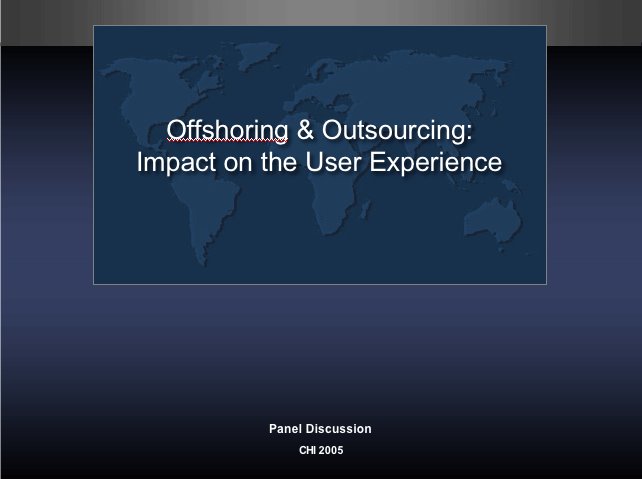
At CHI 2005, I moderated a panel entitled, ("Outsourcing and Offshoring: Impact and Consequences for the User Experience." Panelists discussed issues such as the impact of:- time, language, and cultural differences;
- the nature and level of process development;
- infrastructure (both electronic and physical);
- location of users relative to offshore teams;
- level of training and expertise offshore; and
- characteristics of the work being offshored.
As SIGCHI's Local Chapters Chair for 5 years, I somewhat unknowingly helped make offshoring of user experience work a fact of life, working with people around the world to help them set up and successfully lead and manage regional and national HCI communities. Countries in which I helped establish and grow SIGCHI chapters included India, Russia, Romania, Brazil, Korea, South Africa, Poland, Mexico, Czech Republic, Israel, Chile, New Zealand, and Bulgaria, many of which are identified in a January 2006 issue of BusinessWeek as countries competing for offshore outsourcing by U.S. and Western European companies.
For those 5 years, I worked with (prospective) chapter leaders from long range as well as face-to-face, bringing many of these leaders together for annual workshops. I wrote and edited numerous articles to help (prospective) chapter leaders in all locations; articles included:
- Shaping the Roles to be Played During the 21st Century by Local Chapters of ACM SIGCHI, an article about the workshop for which I brought together leaders of 27 chapters from 18 countries;
- How New Local Chapters Work: The Experience of Czech SIGCHI, an article by Pavel Slavik and Boba Mannova about Czech SIGCHI's first two years and its plans for the future; and
- Diversity Within Unity: The Purpose of a Local SIG, about variations in chapter purpose and approach around the world.
Now, I'm a member of the Executive Council of the User Experience network (UXnet) which has Local Ambassadors in a rapidly increasing number of countries (25, I believe, as I write this) working to foster the growth of user experience communities and to facilitate networking among them (see UXnet Local Ambassadors: Building a Global Community One Locale at a Time). And I'm presently interacting with people in Asia and elsewhere to make UXnet's Advisory Board international.
I have also led expansion of user experience capability outside of the U.S. within businesses which have employed me, working with and within offices in multiple countries to develop and promote their user experience practice. I have hired, managed, coached, and advised individuals and teams in these offices, and worked to improve working relationships of user experience personnel with others within as well as across geographic boundaries.
I am very proud of all of this work, and I've delighted in getting to know and work with so many people around the world, traveling to Italy, France, Netherlands, India, Australia, Germany, U.K., Austria, and elsewhere to make it happen. Indeed, I hope much more work and travel of a related nature lies ahead for me.
Last November, I visited Microsoft Research Asia in Beijing to learn more about Neema Moraveji's exploration of issues of designing for the Chinese. As I stated in a recent blog entry:
"Great dividends await those companies who put ample resources in understanding the culture and living patterns of emerging markets, and in applying that understanding to identifying new opportunities for design for user experience."Presently, I'm learning Mandarin via podcasts. I would have benefited from such learning when in Beijing last year, though I was able to get by reasonably well as the use of the English language in China is increasing. However, knowing more Mandarin than I did is important.
Offshore, and the offshoring of, user experience work is a reality that will increasingly affect us all.