Tuesday, July 31, 2007

On "green design"

This past Thursday, I attended two presentations on "green design." Late in the afternoon, Terry Swack, Founder & CEO of Clean Culture and pictured at right, spoke at PARC on "Sustainable Product Design." Then, during the evening, frogdesign hosted a panel in San Francisco entitled, "The Many Shades of Green."

As reflected in both of those presentations and their content, green design is big these days, and for very good reasons. Burning Man has even gone green this year (in a manner of speaking)!

But as Terry put it:
"Many companies are beginning to understand what they need to do, but they just don't know what's most important and where or how to begin."
Hence, to borrow Terry's quote from Joel Makower's blog:
"...the pace of change seems oh-so slow" (October 2006)
It is interesting that both of the above quotes are akin to what many still say in reference to experience design rather than sustainable design. Indeed, there is lots of overlap in the nature and flavor of both conversations.

Consider these additional quotes from Terry's presentation, which are also akin to what is often said about user experience:
"...(corporate social responsibility) can be much more than a cost, a constraint, or a charitable deed—it can be a source of opportunity, innovation, and competitive advantage.” (from "Strategy and Society: The Link Between competitive Advantage and Corporate Social Responsibility," December 2006)

"For change to occur, life cycle mindsets (must be) adopted and incorporated during conceptual product design stages."
Hence, those focused on moving user experience into a position of greater corporate influence might have something to learn from those focused on moving sustainable design into a position of greater corporate influence, and vice versa.

For example, an interesting strategy initiated by frogdesign is what they call the Kyoto Treaty of design (see Valerie Casey's "The Designer's Dilemma," Summer 2007). Outlining basic tenets of "a call to arms for the creative community around environmental stewardship," this treaty has, according to Valerie, been signed by every consultancy frogdesign has approached, thus increasing the chances the principles will be followed by any consultancy a company might take their business to. This is reminiscent of Clare-Marie Karat's efforts back in 1998 at getting companies to endorse a Computer User's Bill of Rights. Might there be other applications of such a strategy?

And what about green design of user experience?

In a paper that received the Best Paper Award at CHI 2007, Eli Blevis (pictured at right) "presents the perspective that sustainability can and should be a central focus of interaction design."

Jon Kolko and I, the incoming Editors-in-Chief of interactions magazine, are delighted that Eli will be contributing editor for an article on sustainable design for all issues of interactions magazine beginning in January 2008.

---
The Venn diagram is from Adam Richardson's "Tragedy of the Commons," Summer 2007.

Monday, July 23, 2007

Secret agent (wo)man?

At last week's BayCHI Usability Engineering Birds-of-a-Feather meeting, Anita Salem and Cynthia King presented the results of a highly-rated workshop conducted at UPA 2007. "In the workshop, experienced practitioners came together to look at how a richer understanding of change can help usability professionals create more sustainable user-centric organizations." The title of the workshop: "Beyond ROI: UCD as a Catalyst for Organizational Change."

The focus of much of the evening was John Kotter's eight stages of change and the actions that could be taken to achieve each stage as brainstormed by the workshop participants.

The eight stages:
  1. Create a sense of urgency
  2. Create a guiding coalition
  3. Create a vision and strategy
  4. Communicate the change vision
  5. Empower broad-based action
  6. Generate short-term wins
  7. Consolidate and produce more change
  8. Anchor new approaches in the culture
In a paper presented at DUX 2003 entitled, "Using a Change-Management Approach to Promote Customer-Centered Design," Stephen Sato and Andrew Panton described how Kotter's eight stages of change had helped them to institutionalize a customer-centered design approach within the product development organization of a division of Hewlett-Packard in Bristol, UK.
"Introducing the customer-centered design approach at the appropriate phase in the change-management process was crucial to its adoption.

... In order for the customer-centered approach to become institutionalized, the authors recognized that they needed to go beyond just changing practices in product design, and needed to affect changes to the organization structure, processes, and culture."
The advisability of considering the larger framework of organizational and cultural change has been recognized by others as well. For example, Don Fotsch, VP User Experience | Design & Product Planning at PayPal, keeps a handout at his desk which he received during a change management course he took when getting his MBA. The handout -- "Diagnosis for Organizational Design" by Robert Duncan -- describes a seven component design framework to help explain why an organization functions in the way it does, and provides guidance for analyzing how the seven components reinforce each other.
"When considering change, all seven components must be considered, and if one is changed it is most likely that the other components will have to be changed to be consistent with each other."
In an article entitled, "Connecting Cultures, Changing Organizations: The User Experience Practitioner as Change Agent," Paul Sherman wrote:
"As UX professionals, we have many tools and techniques available to us, and we contribute to our product teams in many ways. However, while having good UX skills is necessary, it is not alone sufficient. No matter the size of our organizations or the domains we work within, our most valuable contributions are not our design or user research efforts. Rather, our most valuable contributions occur when we function as change agents."
And during the session I led at CHI 2007 entitled, "Moving UX into a Position of Corporate Influence: Whose Advice Really Works?", Secil Watson's concluding remarks included:
"Think of yourselves as change agents. If you like that role, then look at of yourselves as the people who can really change the culture of the organization you are a part of."
(Secil is Senior VP of Internet Channel Strategy at Wells Fargo.)

However, I recently read an entry in someone's blog -- which, unfortunately, I'm unable to locate again -- which argued that user experience professionals should NOT reveal their intent to change an organization's culture, since doing so will increase the resistance they are likely to face. This argument reminded me of a 1995 article in Communications of the ACM entitled, "Succeeding as a Clandestine Change Agent," in which C. Dennis Allen wrote:
"This was my challenge: to change a development organization of hundreds of software engineers without letting them know it. The goal is the success of the organization, not necessarily to receive credit for your own contributions. ... Since talking directly to upper management had failed in my previous situation, I decided I would try a longer term, grass-roots strategy. ... I wanted to avoid the risks of cross-organizational antagonism that often leads to failure when one group is trying to 'fix' another group in the company."


However, in today's world, I'm not sure it remains as advisable to be clandestine and to not talk directly with upper management. Today, openness and enlisting everyone's support as well as their participation has a greater chance of success and might very well speed up a process which in many organizations has taken many years to achieve, some of which your company might not be able to wait.

Saturday, June 30, 2007

Hail to the Chief!

From a press release of last week:
"Cleveland Clinic has named M. Bridget Duffy, M.D., Chief Experience Officer, a newly created role designed to ensure all aspects of the patient experience at Cleveland Clinic meet the highest standards.

'We recognize that delivering World Class healthcare requires a lot more than providing patients with access to leading-edge treatments and technologies,' said Delos M. 'Toby' Cosgrove, M.D., CEO and President of Cleveland Clinic. 'As a leading healthcare provider, we must exceed the expectations of those we serve, offering compassion, showing empathy and providing patients with the responsiveness they deserve. With her passion for patient-centered initiatives, Dr. Duffy is the ideal person to oversee the Clinic’s efforts to provide a world-class patient experience.'

As Chief Experience Officer, Dr. Duffy will advance Cleveland Clinic’s Patient First Initiative by creating a culture that addresses the emotional and physical experience for the patient, restores empathy as a core value and recognizes the central role that employees play in delivering an exceptional patient experience."
During May of 2005, I posted an article entitled "The Chief Experience Officer" in my blog, refering to Challis Hodge's 2001 description of the role ("...should ensure that an organization delivers the appropriate experience at every point of contact it makes with the public") and to Jeffrey Rayport's March 2005 related description and his recommendation that companies create the position:
"To ensure desirable customer experiences, companies must appoint dedicated chief experience officers. Call this individual the 'other' CEO—or, as we prefer, the CXO (not to be confused with the commonly used term that refers to any C-level executive)."
In an article published later that year, Bill Buxton argued for the need for a CDO:
"Is design leadership an executive level position? Do you have a Chief Design Officer reporting to the president? My view is that if you do not, you are not serious about design or innovation. Furthermore, you are telegraphing this fact to all of your employees, along with a clear message that they need not be either. As a result, you might as well fire all of your creative people, since you are setting them up to fail anyhow."
During 2006, James Gilmore and Joseph Pine of "The Experience Economy" fame chimed in with an article entitled, "Wanted: Chief eXperience Officers," and Bruce Temkin of Forrester Research began to advocate for a CC/EO -- a Chief Customer/Experience Officer. This year, additional advocates have surfaced (e.g., see "The New CEO -- Chief Experience Officer").

However, in the upcoming issue of interactions magazine, Jonathan Arnowitz writes:
"Tuesday's offerings (of CHI 2007) included a panel organized by Richard Anderson titled, 'Moving UX into a Position of Corporate Influence: Whose Advice Really Works?' Much to our surprise, the panelists all seemed to scoff at the idea Richard posed: the need for a chief design officer or chief user experience officer or an alternate C-level design presence. One commentator said, 'The last thing you want is the board dictating the colors or fonts or other designs.'"
Jonathan did not agree:
"The panelists here were completely off base. The chief design officer (CDO) concept is meant to avoid this very thing. A CDO should set the design strategy for the company and make sure it stays on course. Being a C-level officer, the CDO has enough clout to keep boardroom design from taking place."
Why did my panelists not like the idea?

Panelist Secil Watson, Sr. VP of Internet Channel Strategy at Wells Fargo, said:
"My one worry is that there are only so many things you can divide up in terms of accountability, so if you say you are the Chief Experience Officer, there is not much that you are accountable for yourself. ...that accountability truly lies across the organization."
Blogger Eric Mattson appears to agree with Secil, as suggested by his words of earlier in the year:
"Experiences are core to a multitude of management roles already in existence. The last thing you want to do is seperate responsibility for great experiences from marketing, customer service, sales, training and product development.

It's like hiring a chief ethics officer to make sure your organization is honest."
Two panelists argued that the role of the CXO (or CDO or CC/EO) should be played by the CEO (i.e., the Chief Executive Officer). Indeed, Jonathan Arnowitz and others claim that the CXO and CEO are one and the same at Apple. But few CEOs can do what Steve Jobs does when it comes to design and user experience. (Plus, it is not necessarily the case that a successful CXO need be as "hands-on" as Steve Jobs.)

Panelist Jim Nieters, Sr. Manager of User Experience Design at Cisco, argued that it would be difficult for anyone in such a role to have anything but symbolic value at Cisco:
"There is a Senior VP in charge of our security products -- that person defines strategy. Our Chief Security Officer is more of a visible function -- more of a political function. That person goes and talks with people out in Washington and that kind of thing. So, I'm not sure that a Chief Experience Officer would be able to make an impact in the company, because we are very stove-piped as a company -- we have business units and technology groups -- it is like a kingdom -- every business unit is its own profit and loss center, and each of the executives owns everything..."
Panelist Jeremy Ashley, VP of Applications User Experience at Oracle, was the panelist who expressed concern about "the board dictating the colors or fonts or other designs." However, he also said "it would be very good to have an advocate at that level, especially because then that advocate also controls budget, and we all know that budget is king."

And panelist Justin Miller, Sr. Director of Product at eBay for Europe, had this to say:
"I mentioned earlier that I don't think having a Chief Experience Officer is the right direction, because you don't want to have all of your other organizations not focused on it. But where I think we generally get stuck -- and maybe this is true industry-wide -- but certainly at eBay, is that we think of the user experience of the site, or the user experience of whatever product. I think that is a very narrow view.

What we have got to be thinking about is the complete user experience, the holistic user experience, which includes the word of mouth they hear, the marketing they see, the experience they have on the site, the experience our customers have when they talk to customer support, ... All of that is part of the user experience, and I haven't seen very many companies tackle that issue. That is a place for a C-level user experience person -- someone who can be looking across the organizations, someone who is not directly responsible for the user experience on the site, but helping customer support, marketing, the product or website, etc. work together to create a holistic, collective, positive user experience that reflects the brand promise."
However, Justin's interpretation of the role might not be equivalent to Jonathan's. Lou Carbone has expressed concern about multiple interpretations, writing that the "definition and interpretation of the role and function of a Chief Experience Officer tends to be all over the board..."

Consider, for example, what Gilmore and Pine identify as the CXO's primary responsibility: to "develop, launch, manage and refresh a rich portfolio of paid-for experiences...created specifically to generate new sources of revenue and profits in an increasingly commoditized world."

Hmm... That definition and interpretation appears to be far different from that intended by the people at Cleveland Clinic or by most others referenced in this article.

Carbone's words of caution continue: "in far too many instances, both the people appointing the chief experience officer and the individual that’s appointed, don’t have the foggiest notion of what that role and function entail."

Challis Hodge, Jeffrey Rayport, Jonathan Arnowitz, Bill Buxton, Bruce Temkin, and Justin Miller are among those who have some pretty clear notions which, while not necessarily equivalent, would benefit lots of companies.

Quoting Jeffrey Rayport:
"The new executive must relentlessly focus on unifying the disparate functions of human resources, marketing, operations, sales, service, and technology. For most companies, such integration suggests an unholy alliance of warring fiefdoms and silos, and that's precisely why the C-suite needs an individual with the power and authority to deliver integrated experiences for customers."
As Jonathan entitled his upcoming interactions magazine article, "Enter the Chief Design Officer! Hail to the Chief!"

Thursday, June 21, 2007

Already at work as Incoming Editors-in-Chief of "interactions" magazine

Recently, Jon Kolko and I were appointed the next Editors-in-Chief of interactions magazine. (That is Jon at right on the cover of his recently published book.)

Though our first issue will not appear until January 2008, we have been working on fleshing out our vision for the publication, reconceptualizing the editorial board and structure, extending invitations of participation, meeting editorial and design staff, developing a strategy for a web presence, and much more.

Last month, I asked "How would you change 'interactions' magazine? What is missing? How could it be improved? How could it become more valuable to you?"

I've received responses from many, but I look forward to also receiving a response from you.

---
Many thanks to Ken Korman, Denise Doig, Mark Mandelbaum, Brooke Hardy, Andrij Borys, Alicia Kubista, and others for helping to make our interactions meetings in New York City both highly productive and enjoyable.

Friday, June 15, 2007

Breaking silos

In an April blog posting entitled, "Breaking silos," David Armano described the value of shared project ownership among multiple Flash/Ajax developers in his place of work.
"Each touches a part of the project... Sometimes it's at the same time. Other times it's not. No one has clear ownership... Territories don't exist... It's a shared goal -- a purpose. ... It's organic. It's collaborative. It works."
And he suggests that others can benefit similarly:
"Tip for all the executives out there. ... If you find yourself working in silos -- ask yourself why this is. If our people in the trenches can work this way -- so can we."
However, is sharing ownership across disciplines or functions or business units like sharing ownership among multiple Flash/Ajax developers?

In the world of user experience, one of the challenges to shared ownership across disciplines is the lack of respect some disciplines have for others. Bill Buxton and Cliff Nass discussed the difficulty some people have trusting the expertise of others during my interview of the two of them on stage at CHI 99. Some of Cliff's words on this matter:
"There's been this idea that somehow design is this richy democratic process where we all listen to each other, we're all expert, we all take each other seriously. I don't think that is fully true. I think a better model is that we figure out who knows the most about an area and listen to them most closely. The artist should listen to the social scientists about social science and to the technologists about technology...be informed about the true constraints and the opportunities. But the artists have to be trusted to do art; social scientists and technologists shouldn't be doing art. Nor should artists be doing technology. Since it's really hard to be good at one of these things...let alone two or even three...I think that division of labor makes sense. This idea of participatory design is a good one, but not when it means the abdication of expertise.

I was once teaching a class at Stanford, which often has these democratic impulses, and I said, 'I can't remember who said this particular quotation: A or B.' One of the students raised their hand and said, 'Well, let's take a vote on it!' That idea about voting about facts...about voting about what's true, while it is charming and feels good, doesn't result in the best designs."
Some of Bill's words:
"I want to find out how to have the skill of user interface design understood so that people will respect it in the same way that they respect the skill of hacking an operating system or designing a microprocessor. Since the skill of design is not well understood, everybody is an expert, and they all have an equal vote. There's no other discipline that I'm aware of where everybody has an equal vote regardless of their skill or expertise."
Bill said similar things during a presentation at Stanford University earlier this month, telling a story about how the CFO and Head of HR had all sorts of input to product design at Alias | Wavefront (where Bill was Chief Scientist for many years), yet Bill was permitted no input into how corporate finances were handled.

Also earlier this month, the VP of a large user experience organization told me about having earlier in the day cut off a marketing manager who, during a design review, was about to recommend changes to some wording on a redesigned webpage. He explained to the marketing manager that the content personnel had that part of the design covered, and he told me of how his organization's content managers were just starting to get their feet under them again after having had their work messed up for a very long time by product managers. (See "Borrowing from the field of child development..." for references to more stories of this nature.)

However, in a blog entry I posted in March (a posting recently republished in UX Magazine), I referenced situations in which "checking your disciplines at the door" can be beneficial.

And as Claudia Kotchka, VP of Design Innovation & Strategy at P&G, argued during her recent presentation at Stanford, "turf wars are unproductive and never lead to design succeeding."

The issue of ownership of the user experience was among several issues addressed during a CHI conference session I led last month, and session participants had differing perspectives on this issue. One participant advocating shared ownership was Secil Watson, Senior VP of Internet Channel Strategy at Wells Fargo. In my view, Secil's perspective is particularly insightful, as reflected in her words below which come from communication with me prior to the conference session:
"In our Internet channel strategy team, ... we have different disciplines represented: UI design, IA, content strategy, UI development, customer communications, servicing experience, product management, strategic planning, market research, user research, syndicated research, metrics analysis, statistical modelling, process consulting and business and technical architecture.

Their collective goal is to create positive customer experiences, which we believe lead to long term customer value. We think that we can only arrive at positive customer experiences if we collaborate. None of the disciplines can arrive at the right solution in their silos, since they each have a limited vantage point.

The (nearby) 'clover diagram' shows the key questions we all ask, regardless of our competencies. It also shows how achieving positive customer experiences presents an optimization problem. It's not about 'putting the customer at the center'. It's about finding a solution that meets multiple objectives. Finding the solutions require three things: 1. asking the right questions 2. Knowing who to go to to get the right answers 3. Having a culture that supports cross group collaboration (facilitating giving and receiving of help).

Collaboration and integrated work practices are critical. No one discipline can come up with the right answer - they would all only be able to 'locally optimize' their solutions. But putting everyone in the same organization, under the same roof, in the same room are also impractical solutions.

The change has to occur over time and be culturally encouraged: Individuals from different disciplines should know when to ask for another discipline's help, tools and opinions. To facilitate this information sharing, it's also critical that disciplines are open to sharing their tools and findings with other groups.

Asking for and offering help, tools and advice creates an economy of insight. And good insights drive organizations towards a culture that starts asking the right questions more often. At the same time, individuals become better able to connect to the right groups to get the answers to their questions.

My definition of a 'customer centric' culture is where people are asking the right questions to the right people, who are able and willing to collaborate to provide their insights. In such a culture, over time, individuals ask the right questions more often and get the right answers more often. This is a reinforcing feedback loop. As this culture takes hold, more and more of the solutions coming out of the group would yield positive customer experiences. Eventually, the center of the clover would grow...

So, a KPI for 'how customer centric is your organization' would measure how many of the "solutions" an organization creates do fall into the center of the clover as opposed to on one or two of the petals or even worse, outside of the clover."
For more on Secil's approach at Wells Fargo, see "Developing user-centered tools for business planning."

Tuesday, May 29, 2007

Riander Blog receiving growing attention worldwide

I'm delighted that lots of people and companies are finding value in my blog.

People around the world have contacted me about it, and blogs around the world have referenced it.

One of the most notable references appeared in Putting People First, a blog by Mark Vanderbeeken in Italy that is read by approximately 2500 people every day.

Recently, UX Magazine -- a 2007 Webby Awards nominee for Best Business Blog, posted an entry from my blog and added another blog entry to their article editing queue.

And others, including Viaspire -- a 2007 blogger's choice awards nominee for Best Marketing Blog, have posted compliments.

I hope you'll find future Riander Blog postings warrant your attention and others' attention worldwide.

Thursday, May 17, 2007

Metaphors for understanding organizational and process issues

Metaphors come in handy for communicating about and even identifying organizational issues of relevance to user experience. For example, in "Changing the course or pace of a large ship," I wrote about a couple of commonly used boat metaphors:
"... the head of a now large and quite successful corporate user experience organization recently told me, early on (i.e., ~5 years ago when he joined the company as manager of a very small UI group), he felt like he was rowing a small boat to try to change the course of the large ship to which it is attached via a rope.

Interestingly, a director in another very large corporate user experience organization recently invoked a similar metaphor, describing the pace of change he was able to achieve as akin to the pace of an oil tanker rather than a speed boat. However, he was talking about the situation now, not years ago when the organization was in its infancy."
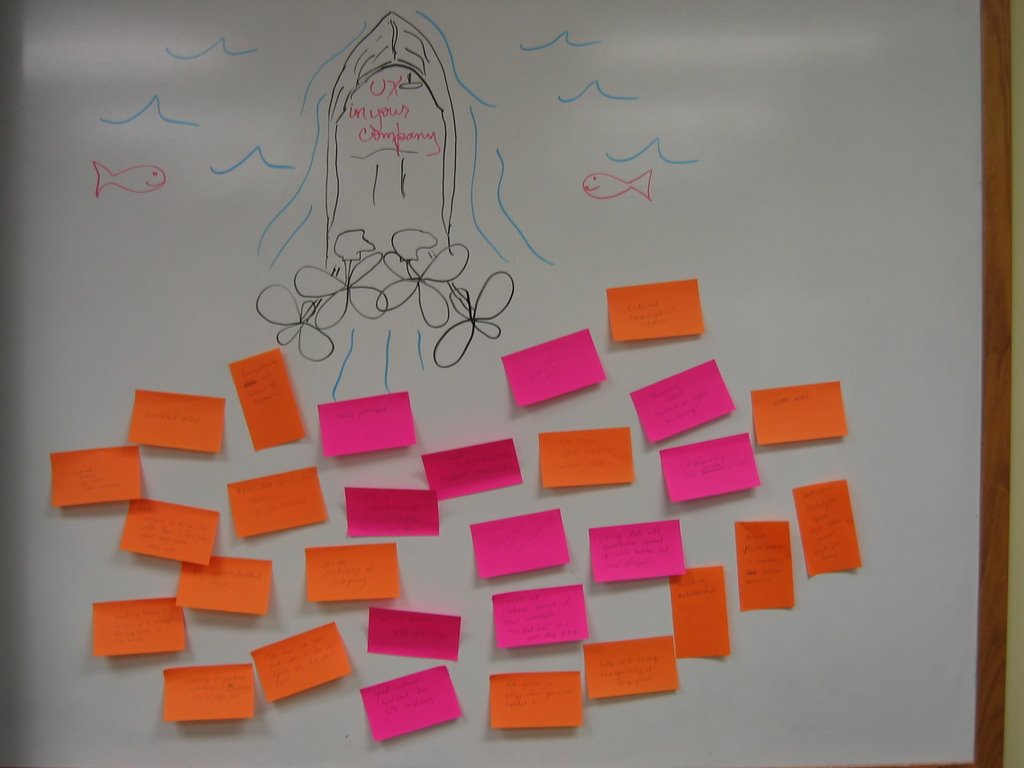
The speed boat metaphor appeared again in "What is holding User Experience back or propelling User Experience forward where you work?", answers to which were solicited from working professionals via collaborative "Speed Boat exercises":
"For one exercise, I drew a speed boat and several anchors hanging from it on the whiteboard, and asked everyone to write onto post-its whatever has been holding User Experience back where they work and then place those post-its on the several anchors.

... To learn what the students believe has been key to propelling User Experience forward where they work (to the extent that it has been propelled or is being propelled forward), I shifted the focus of the Speed Boat exercise from the anchors to -- you guessed it -- the engine propellers (see nearby photo). Interestingly, in several cases, "propelling forward" encompassed "moving upstream," to use yet another metaphor which, at least on the surface, is moving in the opposite direction!

... Why bother with the speed boats and the anchors and the propellers? There are several reasons, but one of the most interesting, in my view, is how they appear to help tap what participants actually 'experience' in their workplace."
And I've referenced other metaphors, including a couple of "three-legged stools" (e.g., of collaboration) that will fall over if any leg is missing.

Recently, I stumbled upon a couple of clever and more complex metaphors of a related nature.

In Thoughts on Microsoft Spark UX Summit, Adam Richardson wrote:
"...I had kind of a funny thought about UX while sipping from a plastic bottle of Ritz Carlton water. I noticed the nutrition label on the water, where everything was 0%. Now if you knew nothing about water and its importance to life you would think it was a completely useless and trivial liquid. It’s all around you and thus taken for granted, and sometimes it’s good and sometimes it’s bad, but exactly why some is good and some is bad you can’t really explain. It suddenly hit me that user experience is treated like water: on conventional business metrics it shows up as a 0 all across the board. However, user experience is something companies deliver whether they mean to or not, but they lack the means to see it or understand how to quantify what makes it good or bad. And increasingly UX needs to be treated as the life-sustaining element that keeps them alive by separating them from the competition. Achieving this requires addition of new metrics that actually reflect it."
And in a paper submitted to CHI 2007's alt.chi venue -- an experimental venue for "unusual, challenging, and thought-provoking work that might not otherwise be seen at the conference," Anna Swartling and colleagues described how a football metaphor can help one visualize organizational responsibility (or lack thereof) for usability.
"In our study of a procurer organization, we saw that even though both procurer and developer were positive towards usability, no one in particular took responsibility for it. Rather, for some, usability was perceived as omnipresent in many processes, and for others, if it wasn't included in the requirements specification, it was more or less absent. Usability was always someone else's problem or responsibility. We came to think of usability being "kicked" around, within the organization as well as during development. This transformed into sports and for us, closest to mind was football."
Anna and her colleagues developed this metaphor extensively, associating various systems development project roles with goal keepers, team captains, the referee, the audience in the stands, the home and visiting teams, and others. And by doing so, they were able to better understand why usability gets "kicked around" as it often does.

As the authors state:
"The advantage of a metaphor is that it enables the possibility to see things from a new perspective."
What metaphors have enabled you or others to better understand organizational and process issues of relevance to user experience?


---
Metaphor is critical to human thinking, particularly when dealing with abstract concepts as so well documented by George Lakoff. Check out the classic Metaphors We Live By for more information.

A user experience metaphor of a different nature that I stumbled upon recently: Mike Kuniavsky's use of magic as a metaphor for the design of ubiquitous computing devices. Those interested in exploring the benefits of this design metaphor should look back in the archives for Bruce Tognazzini's description of the insightful relationship between "Magic and Software Design."

Tuesday, May 15, 2007

So, whose advice really works?

Two weeks ago, I led a session during the CHI 2007 conference entitled, "Moving User Experience into a Position of Corporate Influence: Whose Advice Really Works?"

As I described in a preview, a major focus of the session was five means of -- according to many -- moving user experience into a position of corporate influence: documenting and evangelizing user experience work, owning the user experience, proper organizational positioning, calculating return on investment, and conducting "ethnographic" research. Indeed, according to many, each of these five means is critical to moving user experience into a position of corporate influence. However, one can find arguments against the use or importance of each means. Hence, of interest was which means played critical roles in moving user experience into a position of influence in the diverse mix of workplaces of six panelists, all in or having been in senior management positions via which they have moved user experience into a position of corporate influence.

During the session, I introduced each means, referencing arguments and evidence in support of the means, and referencing arguments and evidence to the contrary. Then, after the audience members proclaimed whether or not they believed that particular means was critical to moving user experience into a position of corporate influence, the six panelists moved to a location on stage reflecting whether or not the means played a critical role in their workplaces (see sample slide).

Note the dissimilarity of the configuration of the panelists in the two nearby photos showing their configuration for two of the five means. Indeed, there was a lot of movement on stage during the session. All six panelists were never together behind the same table, and different combinations of panelists were behind different tables (or "sitting on the fence" in the center) for all five means.

After moving into position for a means, panelists addressed how and/or why the means played or didn't play a critical role where they work.

So, what did the panelists say? Why is it that important words of advice regarding moving user experience into a position of corporate influence should be followed in some cases but not necessarily in all? When should one follow what advice?

The session, which received rave reviews, was recorded for addition to ACM's Digital Library, so you'll all have an opportunity to learn answers to those questions as provided by the panelists via that recording. I'll let you know when the recording becomes available.

However, you can find partial answers to these questions in previous entries in my blog, and I'll address the panelists' answers and the session further in upcoming entries. (I hear that a couple of other people might also be preparing online reports about the session.)

Justin Miller's final words during the panel provide some good overarching guidance. After referring to Jakob Nielsen's stages of corporate usability maturity as providing some good guidance regarding when to do what, Justin said:
"But the really important thing is referenced in the very last sentence of Jakob's article: 'Once you learn how to tickle the organization sufficiently to make it move, you can start planning for your next upgrade...' You have to know how to influence your own organization, because that is what is going to make you successful. And that is going to be different from organization to organization, and within the same organization, it is going to vary over time. So, you've got to be plugged into how to change and influence things where you work, ... and you've got to be sure that you have the right capability (to do that)."
---
Justin Miller is Senior Director of Product -- Europe, eBay.

For a couple of my thoughts on Nielsen's stages of corporate usability maturity, see Changing the course or pace of a large ship.

Photos courtesy of Nancy Frishberg.

Tuesday, May 08, 2007

How would you change "interactions" magazine?

Let's say you had an opportunity to become an Editor-in-Chief of interactions magazine (subtitled "New Visions in Human-Computer Interaction" and a bi-monthly publication of ACM SIGCHI), or that you at least had an opportunity to provide input to the incoming Editor(s)-in-Chief.

How would you change the magazine? Would you change it? What, if anything, is missing? How could it be improved?

I have greatly valued interactions magazine over the years, from the initial issues overseen by Editor-in-Chief John Rheinfrank (the first issue was published in January 1994), through a period of time during which it looks like there might not have been an Editor-in-Chief, through Steven Pemberton's years as Editor-in-Chief, and most recently, while Jonathan Arnowitz and Elizabeth Dykstra-Erikson have been sharing that role.

Indeed, I have quoted and otherwise referenced content from interactions in several of my articles in this blog.

But there are some things about the publication that I think could be improved. Are there some things about interactions that you think could be improved?

Please let me know (riander at well dot com), as I have an opportunity to significantly impact the nature and content of the magazine.

How could interactions magazine become more valuable to you?

Monday, April 23, 2007

Moving UX into a position of corporate influence: Whose advice really works?

I'll be leading an "interactive session" at CHI 2007 entitled, "Moving UX into a Position of Corporate Influence: Whose Advice Really Works?" Here is the abstract:
"Professionals working to move user experience (UX) into a position of corporate influence are impeded by conflicting recommendations, including those regarding the roles of documenting and evangelizing UX work, ownership of UX, organizational positioning, calculating return on investment, and conducting "ethnographic" research. In this interactive session, a group of senior UX management personnel who have moved UX into positions of rapidly increasing influence in their varied places of work debate their different perspectives and approaches to help resolve the conflicting recommendations and generate some new and improved guidance."
A four-page description of this session will be published and will become available in ACM's digital library. However, I've prepared a longer version of the description for you to download.

During recent weeks, I've posted blog entries that provide even more information about the focus of the session:
15 Feb 07: Documenting and evangelizing user experience work

24 Jan 07: Ownership of the user-customer experience

01 Feb 07: Does it matter where User Experience is positioned in your corporate structure?

13 Mar 07 Calculating return on investment

5 Apr 07 Conducting "ethnographic" research
And I recently activated the ability to comment on those postings to invite you to share your stories about your experiences. For example, the first comment to the last posting referenced above is from me and says:
"What has been your experience where you work? Has conducting 'ethnographic' research played a role in moving user experience into a position of corporate influence, or has it not played such a role? If it hasn't, could it? If it has, what role has it played?"
If you'd prefer, feel free to share information about your experiences just with me via email.

The experiences that will receive the greatest attention during the CHI conference session will be those of the following people:
  • Jeremy Ashley, Vice President of Applications User Experience, Oracle
  • Tobias Herrmann, Head of Team User Experience, mobilkom austria (represented by Manfred Tscheligi, Managing Director of USECON, Wien Austria)
  • Justin Miller, Senior Director of Product for Europe, eBay
  • Jim Nieters, Senior Manager User Experience Design, Cisco
  • Shauna Sampson Eves, Director of User Experience, Blue Shield of California
  • Secil Tabli Watson, Senior Vice President Internet Channel Strategy, Wells Fargo
(And I'll contribute a couple of my own stories as well.)

Watch this blog for additional information on the (topic of the) session, but if you are attending CHI 2007, I hope you'll join us Tuesday, 1 May, 14:30-16:00 in the San Jose Convention Center's Civic Auditorium.

Saturday, April 14, 2007

Ramblings on the experience of food -- its preparation, eating, & judging -- and technology

When Claudia and I went skiing earlier this year, we arrived at the Berkeley Ski Club lodge late in the afternoon to find the kitchen starting to fill with activity. "Join us for dinner," said Adrianne Parks almost immediately on behalf of a group of 8 which had made plans to jointly prepare and share the evening meal. And happily we did, joining in the food's preparation, followed by a wonderful, long meal complete with delightful conversation.

I love these kinds of experiences, as reflected in one of my first blog entries, though -- or perhaps "because" -- such experiences were rarely a part of my life until well into adulthood. My upbringing in the center of the U.S. (most often called "the midwest") meant that my participation in meal activity was for years largely limited to quietly eating tasteless food and drying dishes!

Now my experience of food includes shopping and talking food at San Francisco's Ferry Plaza Farmers Market nearly every Saturday, as I described in my reflections on the year 2006.

Indeed, we were there this morning. And when we were there last Saturday, we had the bonus experience of an appearance by Cat Cora in the Ferry Building's Book Passage to promote her new cookbook. I've often enjoyed watching Cat work her magic in competition with other chefs on the Food Network's Iron Chef America.

On Iron Chef America, after two competing chefs prepare 5 or 6 dishes -- each featuring and highlighting an ingredient kept secret until the competition begins, three judges taste the dishes and debate their quality, then rate each chef's output on taste (10 points), originality of the use of the secret ingredient (5), and plating (5).

Comparisons with analyses of user experience by people in the world of technology are interesting. For example, in Technology as Experience, McCarthy and Wright emphasize that user experience includes the emotional, intellectual, and sensual aspects of our interactions. All three of these aspects appear to be embedded in the Iron Chef America scales.

Another example: Mary Beth Raven claims that a world-class user experience has 4 parts: visual style, innovation, execution (defined as attention to detail, emphasis on delighting, and avoiding dissatisfaction), and usefulness. The first three clearly receive the attention of the Iron Chef America judges; I wonder whether the addition of a usefulness scale of some sort could make sense.

Cat, like the other competing chefs, cooks with 2 assistants on the show. Her unique punctuation on this process is the toast of ouzo they share at the end of the one hour permitted for cooking and plating. Perhaps the judges could also rate the teams on how well they worked together. Collaboration in the kitchen can be no less challenging than the workplace collaboration I've referenced in multiple blog entries.

Another type of "collaboration" featured on Iron Chef America is the judging, portions of which viewers get to watch. The interactions among the judges are often as entertaining as they are educational, since they, too, can be challenging, particularly when food columnist Jeffrey Steingarten is a judge.

Maybe Chef Anthony Bourdain will someday rate the judges like he recently rated some of the Iron Chefs and others who appear on the Food Network. Somehow, Cat Cora escaped Bourdain's attention in his no-holds-barred evaluations. I'd most look forward to reading his opinion of Jeffrey Steingarten!


---
Some analyses of user experience, such as David Sward's which is depicted in the nearby graphic (from the February 2007 Bringing the Voice of Employees into IT Decision Making), go well beyond the scope of the Iron Chef America scales. Which analysis of user experience would be most appropriate or beneficial in your world of work?

If you'd like to learn more about Iron Chef America, see Wikipedia's detailed description. Better yet, if you can, just watch the show!

Thursday, April 05, 2007

Conducting "ethnographic" research

I have argued for a long time that use of "ethnographic" research methods can play a major role in moving user experience into a position of significant corporate influence.

And I've referenced at least three examples of this kind of impact in past blog entries:
  1. In my first blog entry of the year, I described how user experience personnel at Wells Fargo embed ethnographic research insights in user-centered design tools they have developed that are increasingly used by business strategists for strategic business planning, facilitating "a transition from a product- to a more customer-centric culture."
  2. In "On concept design, ethnography, MRDs, and product vision" and "Making changes to a company's culture," I described how ethnographic research enabled the conception and design of a new, successful product at Intuit, spawning a series of new products from a company that had been "entrenched in twenty-one years of legacy processes and mindsets" and, hence, hadn't released a "version 1.0" product for many years.
  3. In "Perturbing the ecosystem via intensive, rapid, cross-disciplinary collaboration," I described how involving product management and marketing and engineering personnel in ethnographic research analysis and synthesis at Yahoo! changed a somewhat contentious, confused relationship between product management and user experience personnel into a strategic partnership.
References to additional examples can be found elsewhere. For example, during an October 2006 interview by Mark Vanderbeeken, Anne Kirah said:
“When (Microsoft) hired me eight years ago as the first official anthropologist, they weren’t sure what to do with me, so they had me design my own job. I soon realised that Microsoft had until then the tendency to come up with feature and product designs within the confines of its own walls. ... What went on in the minds of Microsoft’s brilliant software engineers and of people outside the walls of Microsoft, was not always very congruent … so I created the Real People Real Data (RPRD) programme... My work on the RPRD programme was in fact the start of a revolution within Microsoft, and helped the company change from techno-driven to people-driven design."
(Note that later in the interview, Mark asked, "Is Microsoft now a people-centred company?" Anne's response: "Parts of it are, parts of it are not. But that is the direction they are going...")

However, is conducting ethnographic research essential for user experience to have that kind of impact?

At CHI 2007, I'll be leading a session entitled, "Moving User Experience into a Position of Corporate Influence: Whose Advice Really Works?" featuring a group of 7 people who have been or who are in senior management roles in a mix of companies. Though all 7 have helped move user experience into a position of corporate influence, ethnographic research has not played (that much of) a role in all cases.

Why is this?

We'll address these questions, along with related questions regarding "ownership of user-customer experience," "organizational positioning," "documenting and evangelizing user experience work," and "calculating return on investment" during the conference session. And I'll address all these topics further and the CHI conference session itself in upcoming blog entries.

Friday, March 23, 2007

The internal consultancy model for strategic UXD relevance

Jim Nieters, Manager of Cisco's "central" User eXperience Design (UXD) Group, Subbarao Ivaturi, Technical Lead in that group, and Garett Dworman, a Senior Design Architect for Tec-Ed consulting to Cisco, will be presenting an "experience report" entitled, "The Internal Consultancy Model for Strategic UXD Relevance" at CHI 2007.

I interviewed the three of them about the topic of the report last month.

Richard: Why did you choose to write this report for the CHI conference?

Jim: We had seen a lot of discussions about different organizational models at CHI. What we hadn't seen was anybody talking about the internal consultancy model. For example, there was a tutorial done at CHI that talked about different organizational structures. They talked about forming a team around a centralized funding model -- a cost-center model. They talked about structuring a team around a client-funding model where you get money from business units to pay for your team. And they talked about a distributed model where teams sit in the business units. But they didn't talk about an internal consultancy model. And we've found at Cisco that this model has been very effective. So, we decided that it would be worth sharing information about it with the larger community.

Subbarao: We also wanted to educate the CHI community about what experiences we were having at Cisco in using different models -- what successes we've had, what issues we face, and how we are addressing those.

Richard: Describe the internal consultancy model.

Subbarao: We function as a consulting firm within Cisco. We provide services to product teams that request them, but when we work on projects, we go in as a team rather than an individual, emulating portions of what design firms often do.

Jim: A design firm would come into the company, they would bid on a project, and they would assemble a cross-functional team of visual designers, interaction designers, maybe developers, user researchers, usability engineers, ... and they would deliver great value. In our case, we saw that when we had one designer focused on many projects, it was difficult for that person to dig deep, and it really diluted their value. Because Cisco is a technology-led company without full understanding of user experience, we could not afford to continue to dilute our value by delivering incremental improvements. So, we decided to focus on only a few projects very intensively and provide great impact. So, for example, Subbarao has led many teams within the organization that have delivered tremendous value, and he has been allowed to own the user interface, which is a part of our price of entry. Those are projects where we've made millions of dollars for the company. In the previous model, we may have made only incremental improvements which were difficult to measure.

Richard: The title of your report includes the word "strategic" -- it states that this model is for "strategic" UXD relevance. Is that what you are beginning to talk about? Is that why you say the model is important strategically?

Jim: That is exactly it. The typical structure is where one person works on many design projects, and you can afford that in companies where the UXD function is embedded and is a standard part of the process, because teams expect that. Cisco has been a technology-led company rather than experience-led, and we found that we can only make incremental improvement (using that model), and when you only make incremental improvement, the product team can then say a year later, "Well, gosh, it is not a great product; UXD only did a good job, not a great job." We decided that to make sure we had a presence at the table with executives making strategic decisions and to gain the visibility necessary to grow the function within the company, we needed to create a big name for ourselves. And that big name is achieved by working on projects where we can deliver, for example, $100 million dollars worth of impact. At Cisco, we have a huge scale, so $100 million worth of impact is possible, because we go after the projects where there is a lot of revenue opportunity. What that has done has given us a voice at the table from a strategic standpoint.

Garett: I'll interject from an outsider's perspective that at Cisco, there is a need for the UXD team to prove themselves. Many of us have experienced usability as being difficult to bring into design process, since lots of people don't quite understand what user experience means. But some companies are more receptive to that than others. Over the past 3 or 4 years, Cisco has been readily accepting the terminology, and happy to say, "yes, we want user experience." But when it comes to doing it, a lot of the personnel I meet don't really know what it is and don't always understand why it is valuable. They've been told they've got to do it, but they think it gets in their way. They have timelines which are often agressive; they have a lot of other teams they need to get work done with. Why should they bother talkiing with user experience professionals who appear to be slowing down the process by wanting to talk with users, when the product team already knows what users want (or so they think)? So there has to be palpable evidence that this is really worth doing. I think this has forced Jim's hand. Incremental changes are good and important, but people don't notice them.

Richard: It sounds as if there might be times when the UXD group turns down requests for services?

Jim: Many times, in fact. We've changed the dialogue so that we don't have to sell our services. Because of the impact we've been having, we are able to turn people away and choose the projects that are the most valuable -- projects where the people really want to work with us and will partner with us, where there is a big business opportunity so we can show a big financial return, and where executives will be willing to give us some of the credit so that we can articulate that they made a big return on investment in UXD.

Richard: Is there a danger in saying "no" to some requests. Might that not hurt you strategically?

Subbarao: There could be that danger, but with the previous model, we were accepting all requests, and we couldn't achieve the kind of excellence we wanted to on each project because we were spread too thin.

Richard: The internal consultancy model is actually only a part of the overall Cisco model with respect to user experience. Talk a bit about where UXD is positioned elsewhere in the company.

Subbarao: At Cisco, we have three main user experience groups -- one for the Cisco intranet, one for the external-facing cisco.com, and our central UXD consultancy that works on revenue-generating products that ship to customers. There also are smaller user experience groups within business units that are starting to build their own programs.

Jim: Our goal really is to help those product organizations understand the need to build a user experience competency. So we augment those smaller teams. When an organization's UX team can't handle all of their projects, they call on us on a project basis.

Richard: Where is your consultancy positioned within Cisco?

Jim: We're in the Customer Advocacy organization -- an organization outside of Engineering. We've been positioned within Engineering in the past. We've also followed the centralized model and the distributed model -- we've had teams in the business units as dedicated teams. At this point, Customer Advocacy is the voice of the customer to a great extent within the company. So, from our perspective, it made the most sense to locate there. Maybe in the future that should change.

Richard: Say some more about the history that ultimately led you to implement this internal consultancy model.

Jim: When Subbarao joined the company around six years ago, we had a client funding model where business units provided us with some of their headcount. Cisco was growing so fast as a company, that we actually had promises from executives that we were going to be able to hire 60 people in our central organization. It was as if everybody was throwing requisitions at us. Then we had the downturn in 2001. At that point, executives said they had to pull back their funding for UXD headcount. During that transition, we were successful at converting those people to be centrally funded resources. But the challenge with that was that we grew to almost 60 people, and when you grow to almost 60 people, you become a cost center. And when you are a cost center, people target you; even if you are delivering value, it can become a political challenge no matter what company you are in. Hence, we decided that being a cost center wasn't going to be successful. So, we moved out of Engineering and into the Customer Advocacy organization, and decided that we were going to have a smaller group that we would expand and shrink as needed via access to a pool of outside consultants. When a project requires resources beyond what we have in the UXD group, the business unit pays for those resources.

An example of how we do that is the case of a product that Garett, an employee of an outside consulting firm, is working on now with some members of our UXD group. The product team is paying us about $200,000, but we're supplying money as well. Hence, it is a shared model, with the goal of partnering very strongly with the business unit. Neither organization is paying the whole cost. The business unit is trying to start earning $20 million per year more than they are today, and they feel that our help, costing them $200,000, will help them do that. From their perspective, the return on that investment is pretty significant. So, you can see that the business units are providing us with the dollars that enable us to expand our staff as we need to by hiring consultants.

Richard: How well has that worked for you, Garett?

Garett: It has worked very well. In some ways, it has made it much easier for Tec-Ed, my employer, to move from one project within Cisco to the next. We don't have to go through a complete sales cycle each time. Now, when I am working on a project that is coming to a close, we can approach Jim to discuss projects that are coming up for the UXD group that I might move right on to.

There is a slight issue with identity, in that the UXD group wants to expand their ability by hiring outside consultants, but they still want to be seen by the rest of Cisco as just the UXD group. They don't want to be seen as the UXD group and other consultancies. We've been working that out, as Tec-Ed does want it to be known that it is involved in the work.

Jim: The issue of branding -- Cisco-branded, partner-branded, or co-branded -- is something that has to evolve more, because leveraging partnership has to be sustainable for everybody. That is one area of challenge that we have to solve going forward.

Garett: But it hasn't been that much of an issue. And it has been easier for us to consult to Cisco, because I can look to the rest of the UXD group as partners. So, for example, if we needed a report creation module on the project I'm working on now here, I can find out whether someone in the UXD group has worked on such a module on another project, and then leverage that work, which is truly helpful. Before, when I was working on a project for Cisco that lasted a year and a half, I was very removed from the UXD group and was working from a more isolated position; that made it easy for me to clearly say I'm from Tec-Ed, but I couldn't use all the resources of the UXD group.

Subbarao: Another challenge is that the consultants have to be able to quickly learn both the technology and the UXD practices at Cisco. We've tried to address that challenge by developing a pool of consultants that we use a lot, so most of the consultants we bring in already know a lot about the technology and our processes.

Richard: Talk a bit more about the culture of Cisco, and about any other characteristics of Cisco, which make the internal consultancy model advisable here.

Subbarao: The key thing, as Jim and Garett said earlier, is the need to show significant impact to product teams and other decision makers.

Jim: That is right. In the HCI industry, we talk a lot about return on investment and whether you can measure it. As part of the engagement model for the consultancy, we measure the "before" and the "after," and we make sure we will get testimonials from the executives to support our ROI claims. Over the years, the team has had over $2 billion of impact, which is tangible, and we can get testimonials from executives saying that that has been the case. This has made it possible for us to say, "Look at the value; it is a clear return on your investment." With prior organizational models, it was more difficult for us.

Also important is the partnership we establish with the product teams up front. It is a matter of ensuring that we are integrated with the teams and considered relevant by the teams' executives at the very beginning. We get those agreements up front, and that makes a big difference.

Subbarao: And coming out of all this is better user experience. We show tangible value not just in terms of dollars but also in how the user experience has evolved.

Richard: In what (other) types of companies should this kind of model be considered?

Jim: Companies where you don't have company-wide, executive level buy-in but where at least some product teams know they need an improved user experience and are willing to work with your UXD team and allow the team some ownership over the user experience.

Complex systems companies. You can contrast that type of a company with volume operations companies like Yahoo! and Intuit, where user experience is a requirement from the beginning. Cisco is technology-led and was successful as a technology company. We're trying to show -- and I think we are doing that -- that user experience itself can be that next advanced technology, that it is that next thing that can get you a billion dollars.

Garett: Of relevance to that point is the Cisco product I'm working on now. We've learned from customers that they think that the product does what Cisco says it does, and they are happy with that. However, they have had to go to extra machinations to find out whether it was doing what Cisco says it does, because the user interface is not very good. And what Cisco is finding is that competitors are making tremendous headway against Cisco in this product field. There is no evidence that competitors' products work better, but there is evidence that these other products have a user interface that provides users with the information they want about what is going on. With the Cisco product, users are not sure what is going on. It has become pretty clear that Cisco's product would really take off if it had as good or better of a user interface.

Richard: Will the internal consultancy model be best for Cisco long-term?

Subbarao: I think all models have to evolve, but I think we have shown tangible results for this model. When we see significant change in the Cisco landscape around others' expectations or behavior, or regarding how well we can scale our own efforts by staffing more people in-house, at that point we should look at how we should change the model.

Jim: I agree. For example, if Cisco were to hire a Director of User Experience for every major technology group that we have in the Engineering organization, we may be able to become largely a central infrastructure team providing tools, processes, labs, education, career progression, etc. Presently, we don't have the governance across the company that supports user experience actively enough. We only have local governance -- that is, governance at the product team level. Garret is right that the executives are saying the right things about user experience, but until we see it more globally accepted across the company, I think this model works. Once user experience gets accepted across the company, it makes sense to consider a different model.

Garett: I agree. There are two factors. One is resources. The UXD group doesn't have enough resources to cover all of Cisco's needs for UXD, even if it keeps hiring out to firms like Tec-Ed. The second is moving beyond jumping on the bandwagon and using the cool terms that are alive today. Once people understand what those terms really mean and imply -- once user experience has a good hold in the culture, and once there are enough resources, then the UXD group can move on to the next model.

Richard: Thank you.

Saturday, March 17, 2007

Steven Pemberton

I was delighted when I received email from Steven Permberton a couple of weeks ago saying that he'd be visiting the San Francisco Bay Area and asking whether I'd be available to get together.

I was fortunate to have worked with Steven when we were both on the SIGCHI Executive Committee several years ago. Steven was Editor-In-Chief of SIGCHI Bulletin for several years when SIGCHI Bulletin was actually a substantive publication; he was subsequently Editor-In-Chief of interactions magazine (1998-2004). Steven also helped found SIGCHI.NL, SIGCHI's chapter in the Netherlands; hence, Steven also participated in workshops I gave when I was SIGCHI's Local Chapters Chair.

Steven was visiting the area for a meeting of one of the two W3C Working Groups he chairs. This work and some of his other "Projects Past and Present" are described on his home page, where he states:
"If there is one thread that runs through these projects, it is about people. In particular, what are the changes that need to be made to the system architecture to make the resulting system more human oriented."
Steven shared the following elaboration with me:
"One of the main problems with current systems is that they are not built to support usability. Designers are forced to add usability as a layer over the underlying system. And then time and again, for each program anew. Imagine if systems didn't support filestores but only the ability to write bytes to the disk. Then for each program you would have to write the code to deal with files, and you can be sure that each program would have its own filestore bugs, programs wouldn't be interoperable at the filestore level, and there would be acres of guidelines on designing filestores. Well, that's what we have with usability today but on a far grander scale. System architecture is designed by technicians who don't realise the far-reaching effects their design decisions are having. And as a result, usability is a band-aid over the top of bad system architecture."
I asked Steven about the challenges he encounters in his work for W3C in addressing this problem:
"W3C is, of course, essentially technological, though there are areas that are people-oriented, in particular accessibility and internationalisation. I think the problem is two-fold: firstly, W3C is balkanised along the major design axes. There are people thinking about accessibility, device independence, internationalization, and so on, but they are not in general embedded in the groups doing the actual designs, so that often the non-design groups end up writing guidelines - band-aids. Secondly, W3C is member-driven. This is a good thing in general, but it creates a vicious circle: if W3C doesn't do usability, no one from usability will join, and if no one from usability joins, there is no one to demand that it be done. As a result, there is no group responsible for usability within W3C and therefore not enough attention is paid to it."
Steven travels a lot giving keynotes and other invited talks about his perspectives and his work for W3C. Slides from many of his presentations are accessible via his home page, along with audio of various interviews (most in Dutch).

Are you familiar with the concept and experience of a Dutch auction? Over a drink, Steven told me about his first-hand experience. Wikipedia includes a description, but that description fails to mention the second stage that is included for auctions of residences, a process via which Steven and his partner Astrid purchased the residence next to theirs enabling them to expand their residence to accomodate their growing family (those are their two sons riding on the front of Steven's bicycle).

Perhaps Steven and Astrid should expand their award-winning guide to Amsterdam to address Dutch auctions in full. Be sure to access that guide should you be planning a trip to their wonderful city.

---
Top photo of Steven by Barbara Mensink.